Pro AI Writer · Standard
Most keywords don't want a list. They want the topic covered properly.
Standard reads the ten pages ranking now, then covers what they cover at the depth they set. $2 a draft.
- Use it when nothing else fits. — Any informational keyword that isn't a list, a head-to-head or a procedure.
- Three research steps before a sentence. — The live top ten, a crawl of those pages, then the terms and questions Google ties to the topic.
- The outline comes from the gap. — What all ten cover, plus what only some of them bothered with.
- Depth is benchmarked, not guessed. — On auto it targets their average word count plus ten percent, never under fifteen hundred words.
- Your client's real facts go in. — Source-only from the brief. Topics to avoid run as a blackout block.
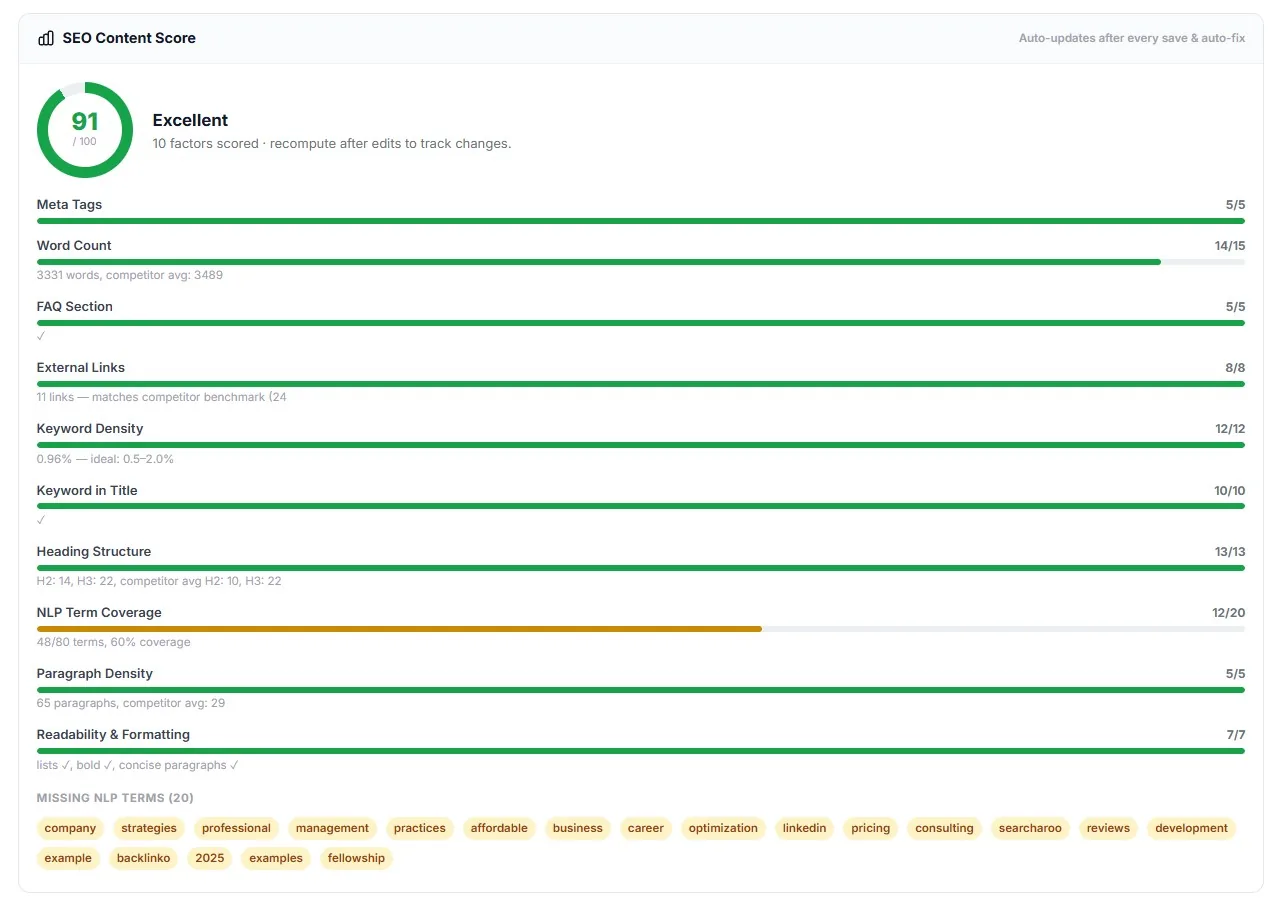
- A score out of a hundred. — Missing terms come back as chips. Term coverage is the heaviest part of it.
- A draft is $2, the same as every format. — Headline options are 40¢. Publishing is free, and a failed run refunds itself.
- A scanner, not a promise. — It rewrites machine-sounding lines. It cannot promise a detector pass.
The format for everything else,
written to the depth that competes.
Google already has ten pages for your keyword.
It learned what a good answer looks like by reading those ten.
Cover less than they cover and your page is not in the running.
Most keywords don't want a list or a head-to-head. They want a clear explanation.
That is what Standard is for. No shape forced onto a topic that doesn't want one.
The outline follows the live results, and so does the depth.
No card required. See every tool and every price before you spend anything.
Run the same keyword on Standard and on a shaped format.
Two drafts at $2 each, and you will see what the format setting is actually doing. The account is free to set up.
No card required. See every tool and every price before you spend anything.
How it works
No shape imposed. The research sets it.
The other ten formats bring a structure with them. This one lets the ranking pages set it.
- 01
Give it the keyword and leave the format on Standard
It is the default for a reason. The format is a real setting, not a line added to a prompt.
- 02
It reads the pages ranking now
The live top ten, read for the subtopics they all cover and the ones only some do.
- 03
That gap list becomes the outline
So the page covers the common ground, then the parts most of them missed.
- 04
Depth is benchmarked, not guessed
Length and structure against what already ranks. Override it if you know better.
- 05
The company brief goes in
Services, wording and topics to avoid, so a general article never claims something they don't offer.
- 06
Score it, scan it, publish it
One click to WordPress or stored login details. Internal links are suggested at publish time.
What lands in your account
A finished article, at the depth that competes.
- The article
- Headed, formatted, at the depth the ranking pages set. HTML ready for the blog.
- A score out of a hundred
- The same rubric every format uses, broken down by category.
- An AI-likeness report
- What the scanner flagged, rewrote and scored. A scanner, not a promise.
- Headline options
- A batch for 40¢.
- A featured image and meta tags
- The image comes from the article opening. Meta title and description only. No schema markup.
A draft is $2. Publishing is free.
Headline options are 40¢. A failed run refunds itself. Credits don't expire.
No card required. See every tool and every price before you spend anything.
The countable part
What it costs and what it does.
- Format
- Standard — the default, one of eleven, set per article.
- When to use it
- Any informational keyword that isn't a ranked list, a head-to-head or a procedure.
- Full draft
- $2 per draft. The same as every other format.
- Headline batch
- 40¢ for a batch of options.
- Featured image redo
- 80¢.
- Publish to blog
- Included. WordPress or stored login details.
- Company brief
- $2, once per client. Refunded if it fails.
- Internal links
- Suggested at publish time. Not inserted while it writes.
- What it does not do
- No schema markup. No detector promise. We publish no delivery date.
What it costs to find out
Price a standard article before a word is written.
The account is free and needs no card. Add a client, open Standard, and the draft price ($2) prints on the button before anything runs.
Creating the account is free. Not a trial that takes your card "for verification" — no card at all, and no call with anyone.
And nothing expires on a timer. Credits sit in the account until you spend them.
When you're ready to spend
$0.35–$0.50
per credit, improving with the volume you commit to
See the full pricing page →What you are not signing
No contract, no minimum, no quote and no call. Buy credits monthly if the volume suits you, or buy a block once and owe nothing after it.
Every deliverable in the platform prints its credit cost on the button that spends it, so you always price the work before you run it.
No card required. See every tool and every price before you spend anything.
Before you ask
The questions we'd ask before pointing this at a client.
- What does a standard article do for my rankings?
- It makes the page eligible to compete. Google measures your page against the ten already ranking, so this reads those ten and covers what they cover, at the depth they set. For most keywords that is the whole job, and it is the part a shaped format can get in the way of.
- Is Standard the weakest format?
- It is the least opinionated, which is a different thing. Every format runs the same fourteen writing steps and is graded on the same rubric. Standard is simply the one that doesn't force a heading pattern onto a topic that never asked for one.
- Will this move my rankings?
- We will not promise that. What we can say plainly is that a page covering less than the ranking pages cover is not competing at all. Coverage, depth and the client's real facts are the parts this controls. The rest depends on the site and the competition.
- Will it pass an AI detector?
- We will not promise that. A scanner on our side flags machine-sounding passages, rewrites them, and reports what it changed. It cannot promise a pass on any commercial detector.
- Where does it publish?
- WordPress, or any blog we can reach with stored login details. Internal links are suggested at publish time. Not Shopify, Wix, Webflow or Squarespace.
- What does a draft cost?
- $2 for the full draft. Headline options are 40¢. Publishing is free, and a failed run refunds itself.
The format for everything else,
written to the depth that competes.
Here is the part that has nothing to do with us. The competitor above your client published four times this month on the boring keywords. The ones with no number in the title. Those pages are covering topics your client's site still says nothing about.
Six months out, one of two things is true. You are still forcing shapes onto queries that don't want them, or every plain keyword has a scored draft ready to publish.
The decision is one line. Is a draft that reads the live top ten and grades its own coverage worth $2 to look at?
P.S. — Worried it will read generic? Build the company brief first. It is source-only from their own website, so the article can only use what is really there. Create the account, open one Standard draft, and read the score panel. No card to get that far.
No card required. See every tool and every price before you spend anything.
The rest of Pro AI Writer