Rank Tracker
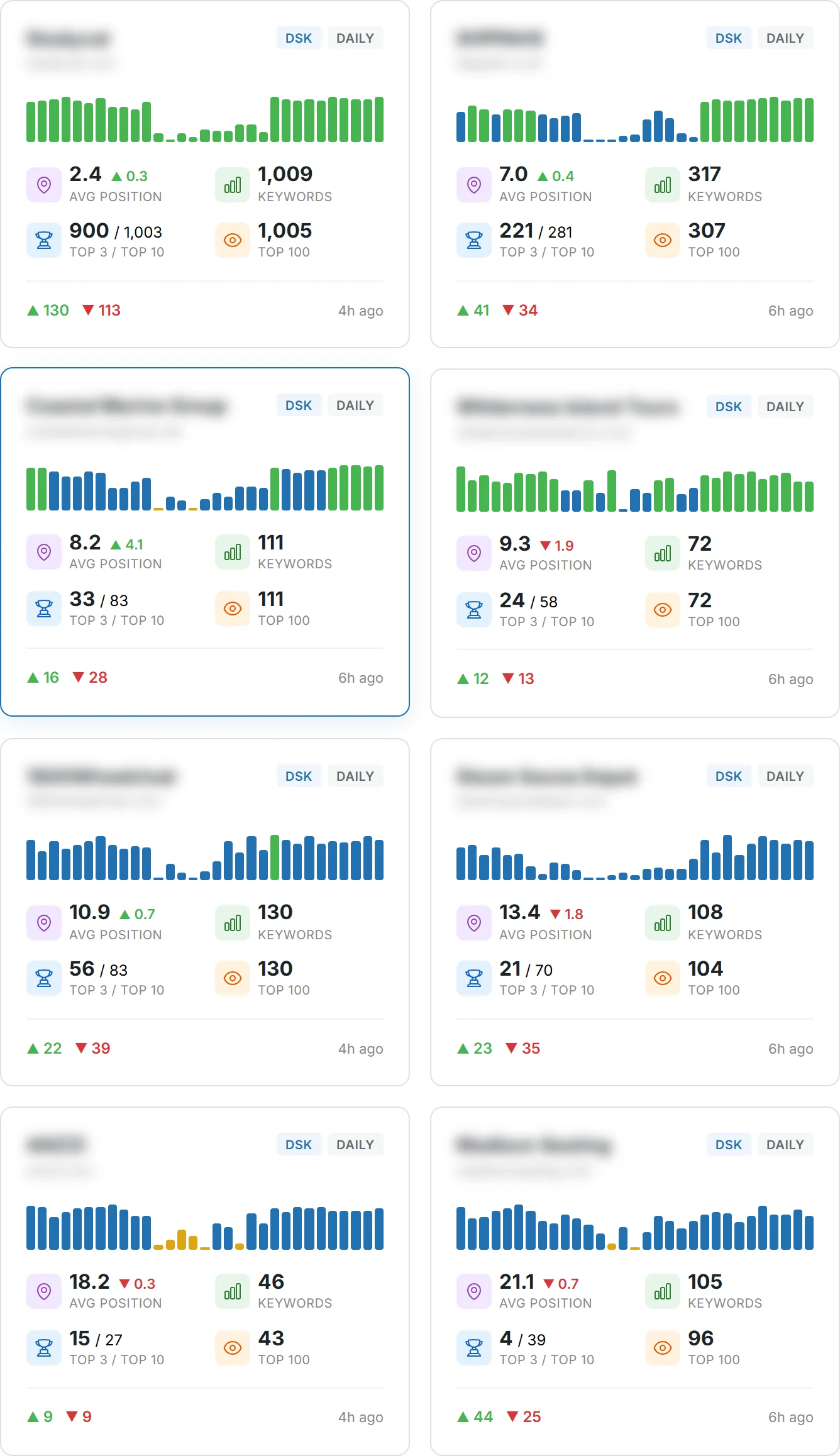
Did the SEO work move anything? This tells you, keyword by keyword.
Positions checked on Google, Bing and Yahoo, as often as you want them. The links and articles you bought sit on the same client record.
- Ranks sit next to the work. — The links, articles and citations live on the same client record as the positions.
- A drop gets checked twice. — No position came back? We look again live before we record a miss.
- Three engines. Two devices. — Google, Bing and Yahoo. Desktop and mobile, never averaged together.
- Map pack, street by street. — A grid shows where the business turns up, and where it stops.
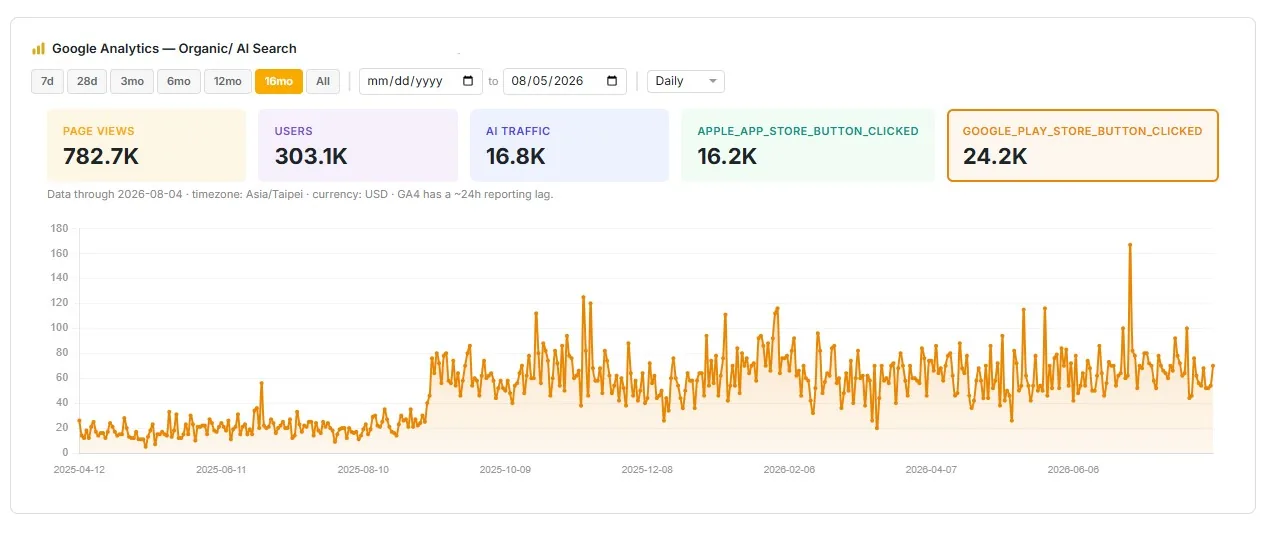
- Search Console and Analytics are free. — Connect them once. Looking at them costs nothing.
- AI Overview comes with the check. — Whether Google named the client comes back free with the position.
- Watch-only keywords cost nothing. — Turn checking off and keep the list. You pay for checks, not for storage.
- Weekly is 12¢ a keyword each month. — Daily is 60¢. The month totals on screen before the first check runs.
- 1,518 of our keywords are in the top three. — Across twenty of our own programs, 670 of them at number one. Ours — not a promise about yours.
See the ranks.
See the work that moved them.
SEO is slow, so the only real question is whether it is working.
A position answers that.
One number, per keyword, per day.
Most trackers stop there. They know the number and nothing else.
This one sits beside the links, articles and citations you bought for that client.
So when a keyword moves, you can see what you were doing before it moved.
No card required. See every tool and every price before you spend anything.
Why most tracking doesn't help
A tracker that only knows the number can't tell you what to do next.
A red arrow on Tuesday. You already knew something slipped.
What you needed was the reason.
A standalone tracker cannot give you one. It never saw what you published or bought.
So its advice comes back as build authority. Thanks.
The links live in one tool. The articles in another. The ranks in a third.
Did the thing I paid for move the number? That question turns into a spreadsheet.
Here they all sit on one client record, so a change has something beside it you can look at.
Now the part we say early. No competitor tracking. No tags or groups. No share of voice.
If you use those three every week, keep your dedicated tracker.
Set up one project and read the free panels first.
No card. Search Console and Analytics light up for nothing. Only a rank check has a price, and it shows before it runs.
No card required. See every tool and every price before you spend anything.
How it works
How a keyword gets watched.
Most trackers only write the number down. This one keeps the work beside it.
- 01
One project per engine and device
Google, Bing or Yahoo. Desktop or mobile. Kept apart, so nothing gets averaged away.
- 02
Add keywords any way you have them
Type, paste, CSV, Campaign Builder, or real Search Console queries. The ones you are not checking stay free.
- 03
Pick daily, weekly, or on demand
Change it whenever you like. Pause without losing the history.
- 04
A miss gets a second look
No position comes back? We re-check it live before we record a drop.
- 05
Scan the map pack as a grid
See coverage across the whole service area, not one pin at the office.
- 06
Reports go out under your logo
Scheduled email, PDF, Drive, client portal. You do not build them by hand.
What you get
History, heatmaps, and a report you didn't build.
Next client call. Share the screen and scroll. You don't have to narrate it.
- Position history you can show
- Per keyword, re-checked before a miss sticks. 2,746,097 data points on our book so far.
- A map-pack heatmap
- Where the business shows up across the area. A picture, not a guess.
- SERP features
- Snippet, local pack, people-also-ask and more, next to the position.
- AI Overview mentions
- Free with the check. Not a separate upsell.
- Search Console and Analytics
- Free panels, sitting beside the ranks.
- A branded report on a schedule
- Your logo. Their inbox. No weekly build task.
Weekly checks are 12¢ a keyword each month. Daily is 60¢.
Priced per keyword, not per seat. Keywords you are not checking stay free. Credits don't expire.
No card required. See every tool and every price before you spend anything.
The numbers
What it tracks — and what it doesn't.
- Search engines
- Google, Bing, Yahoo.
- Devices
- Desktop and mobile, as separate projects.
- Keywords
- No cap. Keywords you are not checking are stored free.
- Check frequency
- Daily, weekly, or manual — per project.
- Active on our book
- 3,918 active keywords across 35 projects and 26 clients.
- History recorded
- 2,746,097 data points across 5,965 keywords. A different count from the active one — don't add them together.
- Where those programs stand
- 1,518 keywords in Google's top three across twenty programs. 670 at position one across sixteen. Ours — not typical, not a promise.
- Search Console (28 days)
- 17,793 queries averaging top three. 5,970 averaging position 1.0.
- SERP features
- Snippet, image, video, people-also-ask, knowledge graph, local pack, shopping, top stories.
- Local grid
- Map-pack position across a service area, drawn as a heatmap.
- Integrations
- Search Console and Analytics, both free to view. Keywords can come from Search Console queries.
- Reporting
- Scheduled branded email, PDF, Drive, CSV, view-only client portal.
- Data hygiene
- A no-position result is re-checked live before the miss is saved.
- What checks cost
- 12¢ per keyword per month on weekly, 60¢ on daily. Grids are charged per scan. Search Console and Analytics are free.
- What it does not do
- No competitor tracking. No tags or groups. No share of voice. Need those? Buy a dedicated tracker. This one comes with the work.
We publish no accuracy percentage and no delivery-date promise. We don't have figures worth quoting.
What it costs to find out
Load the keyword list free. The month of rank checks is priced first.
The account is free and needs no card. Add a client, make a project, paste the list. Search Console and Analytics connect for nothing.
Creating the account is free. Not a trial that takes your card "for verification" — no card at all, and no call with anyone.
And nothing expires on a timer. Credits sit in the account until you spend them.
When you're ready to spend
$0.35–$0.50
per credit, improving with the volume you commit to
See the full pricing page →What you are not signing
No contract, no minimum, no quote and no call. Buy credits monthly if the volume suits you, or buy a block once and owe nothing after it.
Every deliverable in the platform prints its credit cost on the button that spends it, so you always price the work before you run it.
No card required. See every tool and every price before you spend anything.
Before you ask
The questions we'd ask before pointing this at a client.
- What does rank tracking do for my SEO?
- It tells you whether any of the work moved anything. SEO is slow and most of it happens where you cannot see it, so a position per keyword per day is the honest read on it. Here those positions sit on the same client record as the links and articles you bought.
- Will tracking a keyword help it rank?
- No. Checking a position does not change it, and we will not pretend otherwise. The tracker tells you where you stand and shows what was running at the time. The moving is done by the links, the content and the citations.
- Can I track competitors?
- No. No competitor tracking, no tags or groups, no share of voice. This is the tracker that comes with the work, not a replacement for a dedicated one.
- I already pay for a tracker. Why run two?
- Maybe you shouldn't. If you use competitor tracking and share of voice every week, keep that tool. If you mostly want to know whether what you bought did anything, this one already sits next to what you bought.
- How much do a hundred keywords cost?
- Weekly checks are 12¢ a keyword each month, so a hundred of them is $12 a month. Daily is 60¢ each, or $60. Keywords you are not checking are stored free.
- How do I know the history is real?
- A miss gets a fresh re-check before it sticks. The history is kept against the client, not against a vendor login, so it is still there next year.
- Is the local grid the same as a rank check?
- No. A rank check is one point. The grid samples the map pack across many streets, which is how you see coverage rather than an average.
- Can my client see their rankings?
- Yes. View-only on your subdomain portal, with CSV. Or a scheduled email under your logo.
- Does it track AI mentions?
- Google AI Overview comes free with each rank check. ChatGPT citations are a different tool — ChatGPT Mentions, under Tools.
See the ranks.
See the work that moved them.
Here is the part that has nothing to do with us. The site above your client is measuring this every week. Every month you cannot explain is a month you are guessing while they are reading.
Two futures. You keep opening a second tab and saying it takes time. Or one record holds the ranks, the links, the heatmap and a report that already went out.
1,518 of our keywords sit in the top three. Ours, not a promise. Load your list, read the month, and decide.
P.S. — Read the three things this does not do first. No competitor tracking, no tags, no share of voice. If you need them, buy a dedicated tracker. If you don't: the account is free, there is no card, and the month total is on screen before a single check runs.
No card required. See every tool and every price before you spend anything.
The rest of it