Pro AI Writer
Want to rank for that keyword? Cover it better than the ten ahead of you.
Google already ranks ten pages for it. This reads those ten first, then writes one that covers more.
- Google compares your page to ten others. — So this reads all ten before it writes a word.
- Cover what they cover. — Then cover the terms and questions none of them bothered with.
- Length stops being a guess. — It targets their average word count plus ten percent.
- It knows the client before it writes. — A brief crawled from up to ten pages of their own site.
- No invented awards. No invented cities. — It may only use what the client's own website says.
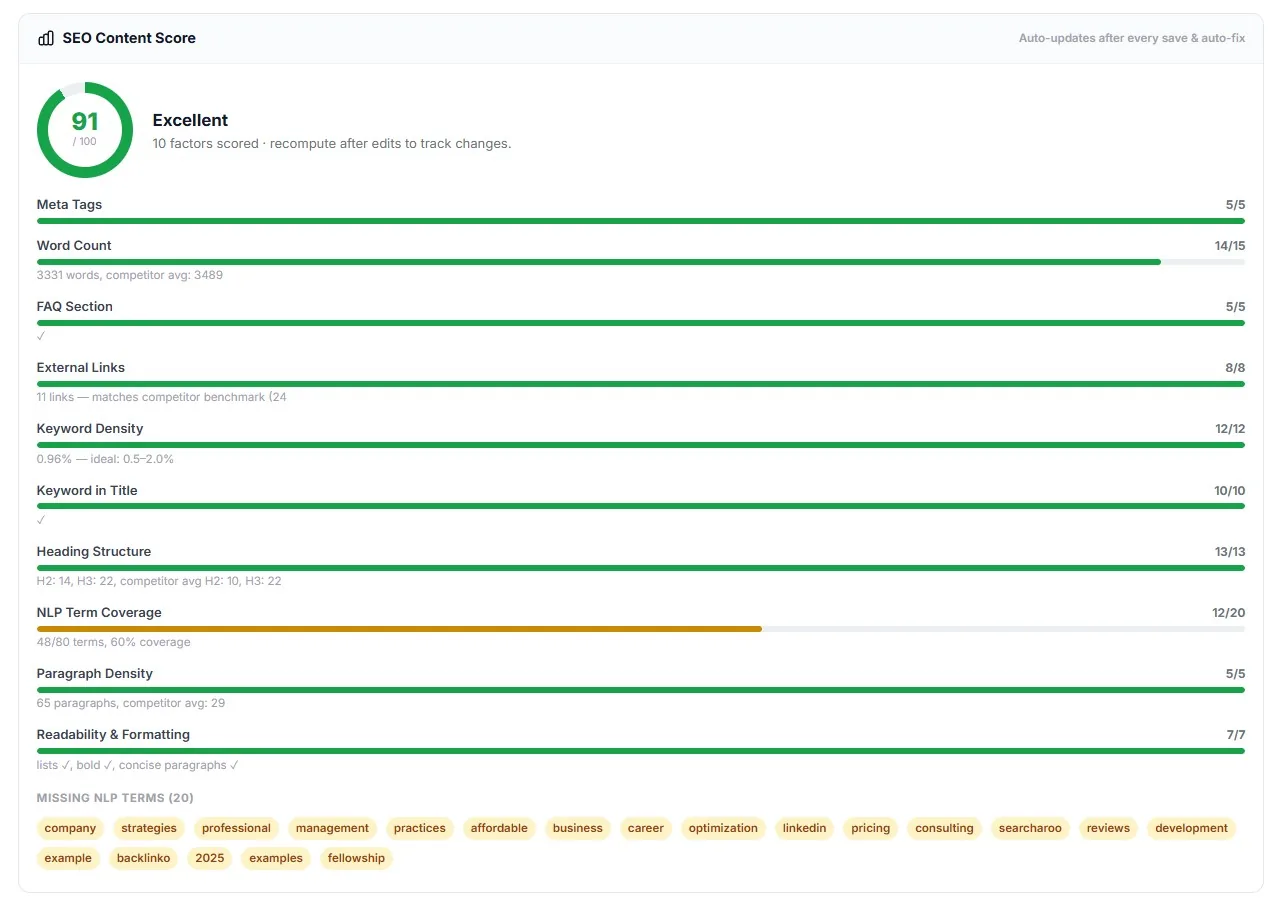
- A score out of a hundred. — It names the terms you are still missing, as chips.
- A scanner, not a promise. — It rewrites machine-sounding lines. It won't claim a detector pass.
- $2 a draft. — Publishing is free. A failed run refunds itself.
An article that covers the topic
as well as the pages already ranking.
Google already has ten pages for that keyword.
It learned what a good answer looks like by reading those ten.
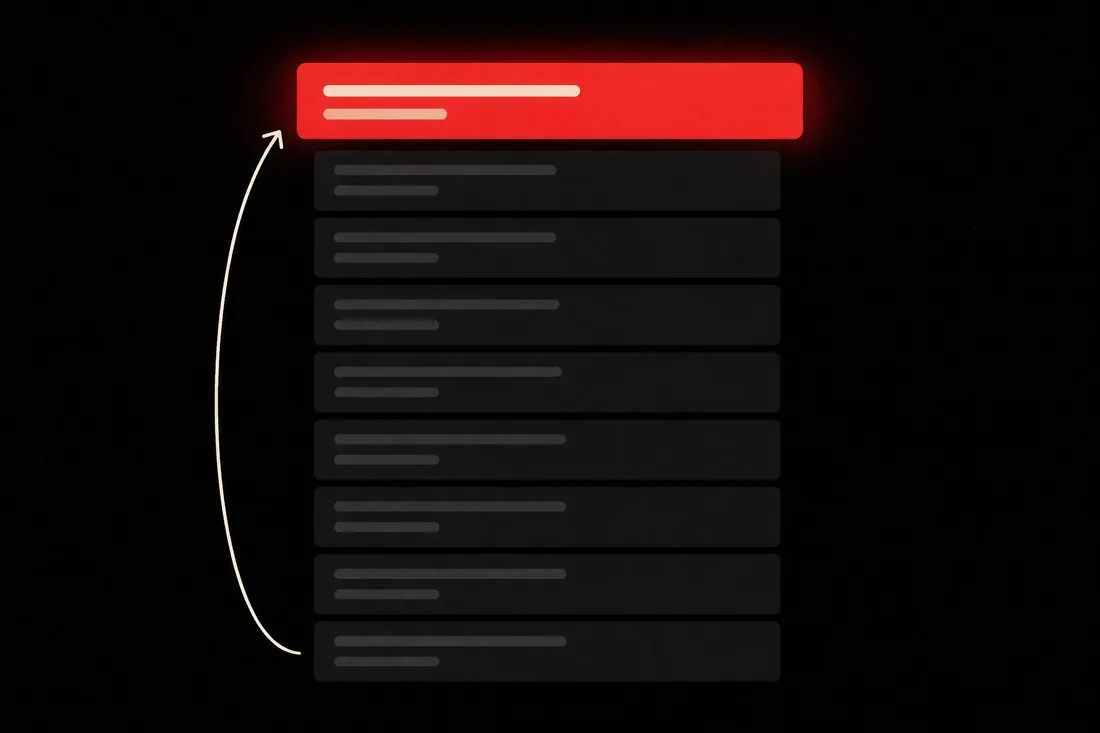
Your page gets measured against them. Miss what they all cover and it never competes.
So this reads those ten first. Then it writes one that covers more.
It also reads a brief built from your client's own website.
Real facts, on a page that covers the subject. That is what eligible to rank means.
No card required. See every tool and every price before you spend anything.
Why most AI content never ranks
AI content fails on coverage first, and on facts second.
Google already has ten pages for your keyword.
It learned what a full answer looks like by reading them.
A page that skips half of what they cover is not eligible to compete.
Most AI writing skips it. It writes from memory and never reads the ten.
Then comes the second failure, and this is the one that gets an agency fired.
A generic writer knows nothing about the business, so it fills the gaps.
A service they don't offer. An award they never won.
That goes out under the client's name, with your invoice attached to it.
So this reads their real facts first. Then it reads the ten pages it has to beat.
And here is the promise we won't make. Every vendor swears the AI detectors will miss it. We won't say that.
Our scanner is local. It scores each section and rewrites what reads like a machine.
But it cannot guarantee a pass on any commercial detector.
Read the brief it builds from your client's website.
The account is free and takes no card. That one document is the whole difference. Nothing leaves your balance to read it.
No card required. See every tool and every price before you spend anything.
The mechanism
What happens before it writes a sentence.
Research runs before a sentence exists. That is where a page becomes eligible to compete.
- 01
It reads the live top ten
Your exact keyword, at the moment you press go. Not a memory of what used to rank.
- 02
It crawls the pages ahead of you
Their structure, depth and length. On auto it targets their average plus ten percent, never under fifteen hundred words.
- 03
It mines the terms Google ties to the topic
Entities, semantic terms, and the real People Also Ask questions. Those become the FAQ.
- 04
It reads your client's brief
Services, geography, tone and the words they use, under a source-only instruction. Nothing gets invented.
- 05
It writes each heading separately
Outline, then every section, then the takeaways. The introduction is written last.
- 06
It scores, scans and fixes
A hundred-point score. A local scanner rewrites machine-sounding lines. Auto Fix for keyword and link gaps.
- 07
It publishes
One click to the client's blog, and the live URL is recorded against the article.
What you end up holding
An article, a score, and a live URL.
Picture the next reporting call. The article loads and the score panel sits beside it. You don't defend the writing. You scroll.
- The finished article
- Formatted, with a meta title, a meta description and an original featured image.
- A hundred-point SEO Content Score
- Term coverage 20, word count 15, headings 13, keyword density 12, keyword in title 10, external links 8, readability 7, FAQ 5, meta tags 5, paragraph density 5.
- An AI-likelihood report
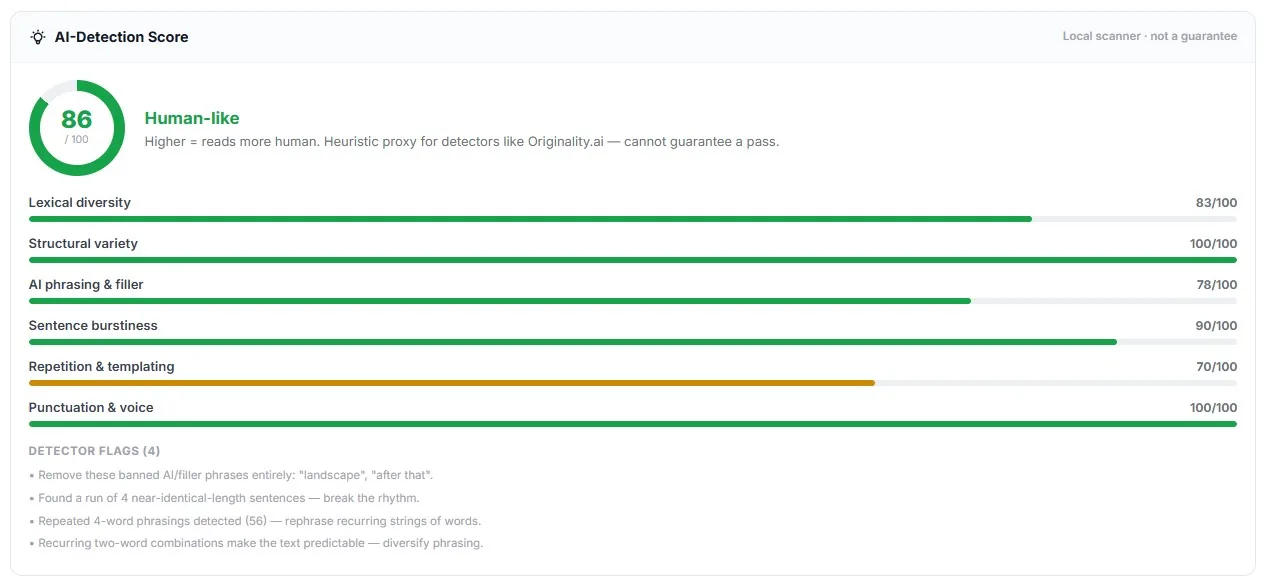
- A human score out of 100 across six checks. A local scanner, not a guarantee.
- Every keyword checked and anchored
- Found versus total, duplicates removed, one correct link per pair.
- The live URL
- Recorded against the article the moment it publishes.
- Or a guest post instead
- Pick the destination when you create it. Same research either way.
A draft is $2. That is the price.
Headline options are 40¢. Publishing is free. A failed run refunds itself.
No card required. See every tool and every price before you spend anything.
The countable facts
Everything you'd check before trusting it with a client.
- Writing steps
- 14, named, in fixed order.
- Article formats
- 11 — Standard, How-To Guide, Listicle, Product Review, News, Comparison, Case Study, Opinion Piece, Tutorial, Roundup Post, Q&A Page. The format changes the outline and the rubric, not just a label.
- Word count
- Auto-targets the competitor average plus 10%, minimum 1,500 words. Or set your own, up to 8,000.
- Scoring
- 100 points across 10 weighted factors.
- Humanizer
- 6 checks, composite 0–100, threshold 70, one retry per section.
- Keywords per article
- Unlimited keyword and target-URL rows on a blog post. Exactly one pair on a marketplace guest post.
- Model control
- A long-form model tuned for this writer. A second frontier model selectable per article. Five image models.
- Audience and persona
- Both auto-detected from the client's brief. Both overridable per article.
- Guardrails
- A master banned-words list stripped from every draft. Layered custom instructions, with compliance and structural rules taking precedence.
- Publishing
- WordPress, or any blog reachable with stored login credentials. Internal link suggestions read the client's own site at publish time.
- What a draft costs
- $2 for a full draft. 40¢ for a batch of headline options. Publishing is free.
- Cost per finished article
- $2.40 with headline options included. Now go price two rounds of edits.
- Company brief
- $2, once per client, crawled from up to ten pages of their own website. Refunded if it fails.
- What it does not do
- It writes meta titles and descriptions. There is no structured-data output. Internal links are suggestions at publish time, not links inserted during writing.
- Delivery date
- We don't publish one. We have no delivery data worth quoting, and a made-up estimate breaks a promise faster than silence does.
Every price above is the live cost on your account, printed on the button that spends it. Dollar figures are quoted at the 1,000-credit plan rate — buy in smaller amounts and you pay a little more, buy in volume and you pay less.
What it costs to find out
Read the company brief before you pay for a single draft.
The account is free and needs no card. Add a client, build the brief, open the writer. Every button prints its price before it runs.
Creating the account is free. Not a trial that takes your card "for verification" — no card at all, and no call with anyone.
And nothing expires on a timer. Credits sit in the account until you spend them.
When you're ready to spend
$0.35–$0.50
per credit, improving with the volume you commit to
See the full pricing page →What you are not signing
No contract, no minimum, no quote and no call. Buy credits monthly if the volume suits you, or buy a block once and owe nothing after it.
Every deliverable in the platform prints its credit cost on the button that spends it, so you always price the work before you run it.
No card required. See every tool and every price before you spend anything.
Before you ask
The questions we'd ask before pointing this at a client.
- So what am I actually buying here?
- Eligibility to compete. Google already has ten pages for that keyword, and it learned what a good answer looks like from them. A page that covers less than they do never gets into the conversation. This reads those ten first, then writes one that covers more.
- Why does covering more terms matter?
- Google ties a set of terms and entities to every topic. The pages ranking now use most of them. The score panel weighs term coverage heaviest, at 20 of the 100 points, and it lists the terms you are still missing as chips so you can see the gap.
- Will publishing this rank my page?
- Not on its own, and we won't promise it. Content is what makes a page eligible to compete — it still needs links pointing at it and time for Google to crawl it. What this removes is the reason most pages never had a chance.
- Doesn't Google penalise AI-written content?
- Google's published position is that it rewards helpful, original content whatever produced it. What it acts on is scaled content abuse — mass-generating pages to game rankings, adding nothing.
- Will this get flagged as AI?
- No tool can promise otherwise, and any that does is selling you something. Our scanner is local. It scores each section across six checks, rewrites what reads like a machine, and hands you the report. It cannot guarantee a pass on any commercial detector.
- How is this different from asking a chatbot?
- A chatbot writes in one pass from memory. This reads the top ten live, then covers what they cover.
- Does it know anything about my client's business?
- That's the company brief, and it's the part nobody else has. Point the platform at your client's website and it crawls up to ten pages. The writer may then use what that brief says, and nothing else.
- What does an article actually cost?
- $2 for a full draft. Headline options are 40¢, which makes a finished article $2.40. Publishing is free and a failed run refunds itself.
- Can I edit what it produces?
- Yes, and you'll want to. The score panel updates after every save and every auto-fix, so you can see what your own edits did.
- Where does it publish?
- WordPress, or any blog we can reach with stored login credentials. It records the live URL against the article.
- What if a run fails?
- The three research steps soft-fail. If a competitor's page blocks the crawl, the article still generates.
An article that covers the topic
as well as the pages already ranking.
Here's the part that has nothing to do with us. The site above your client published four times this month. You published once. That gap grows toward whoever covers the topic better.
So picture six months out. Either content is still the bottleneck. Or every client has a brief and every article arrives scored, and the number on the invoice stopped deciding how much you publish.
The question is one line long. Is a draft that reads the top ten and already knows the client worth $2 to look at?
P.S. — I know what you're actually afraid of, and it isn't the $2. It's publishing something under a client's name that turns out not to be true. So read the brief before you read a draft. The account is free, there's no card, and every button prints its price. If the brief is wrong about them, you've lost a click and nothing else.
No card required. See every tool and every price before you spend anything.
The rest of it