Clients
Every article, link and listing says the same thing about the client.
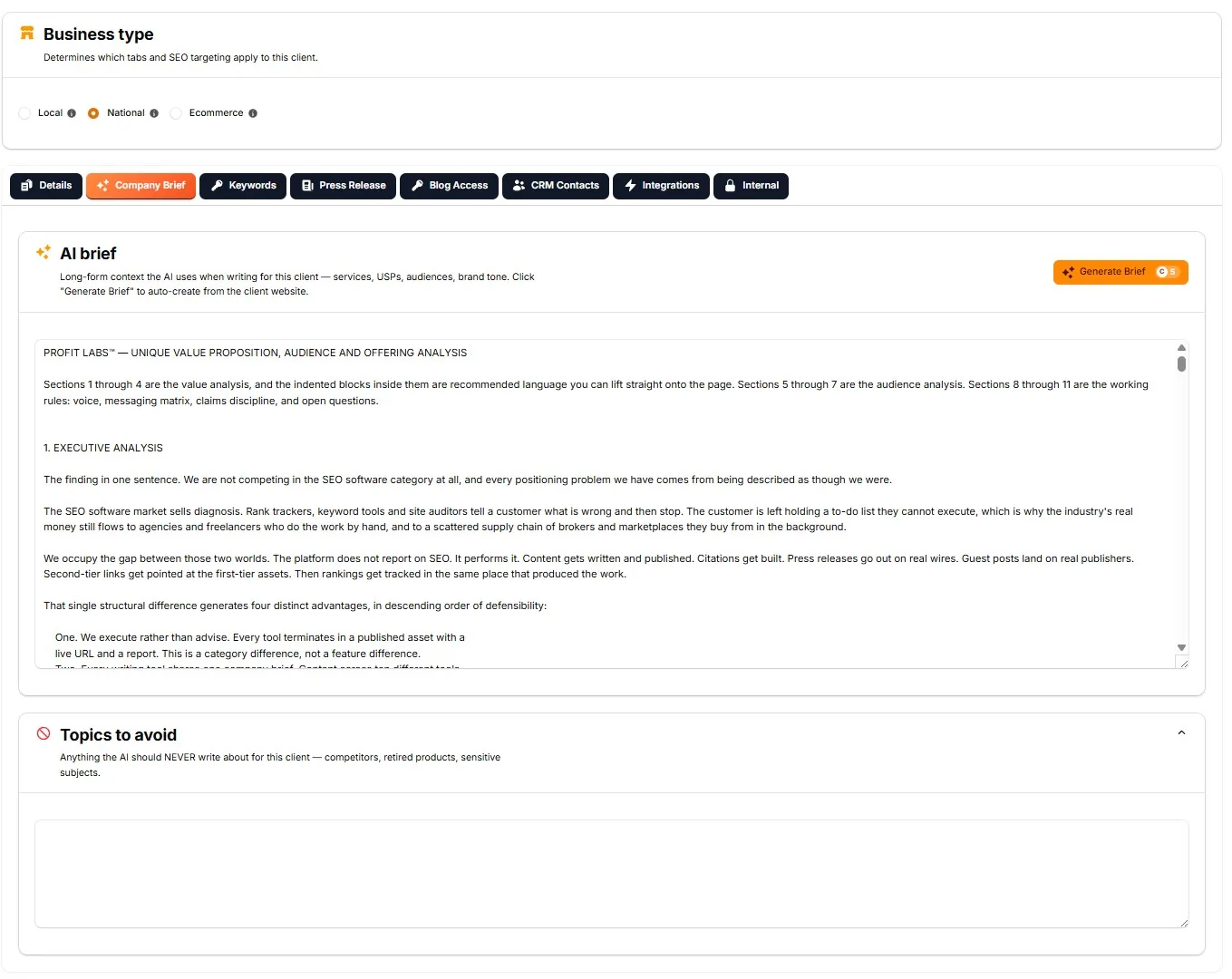
One brief, built by reading their own website. Every writing tool reads it before it writes a word.
- One record, read by every tool. — Articles, guest posts, release topics, citation copy, clusters and images all start from it.
- Topics to avoid is a hard stop. — Competitors, claims, towns and retired products get blocked at the top of every write prompt.
- Built from their real pages. — Up to ten pages of their site. Not a questionnaire nobody fills in.
- One writing rule, and you can read it. — Use only the source material. We quote the exact instruction further down this page.
- One tool skips it on purpose. — Top 10 Listicle has to name competitors, so it ignores the brief.
- The address is stored once. — Name, address and phone for local work. Syndicated copies can carry the citation block.
- Your client signs in on your subdomain. — Rankings and board, view-only. The relationship stays yours.
- White-label means name and logo. — No colour theming. Better you know that before you resell it.
- The brief is $2. — Clients, seats and portals cost nothing at all.
Brief the client once.
Every tool writes from it after that.
Google works out what a business does by reading what is written about it.
Its own pages. Its articles. Its listings.
When those say different things, you have taught it three versions of one company.
A brief holds the real ones: services, towns, audiences, their own words.
Every writing tool reads that brief first.
So the work stays on topic, and it stays about them.
No card required. See every tool and every price before you spend anything.
Why the content misses
Most SEO content is written about nobody in particular.
A writer gets a keyword and no facts.
So the draft comes back generic, or it comes back wrong.
Generic pages do not beat pages that actually cover the subject.
Wrong pages are worse. Those cost you the client, not just the ranking.
The fix is dull. Keep the facts in one place every tool can read.
Now the honest limit. A thin website gives you a thin brief.
We build it from their live pages, because the other option is a questionnaire nobody fills in.
You will edit the first one by hand. Better you hear that here than on the first draft.
Add one client and read the brief it writes back.
The account is free and takes no card. Paste their homepage. See how much of the business it got right.
No card required. See every tool and every price before you spend anything.
How it works
One URL. One brief. Every write uses it.
Paste the site. We read it. We write the brief under a hard rule. Then the writing tools read that brief before they write.
- 01
Create the client record
Name, site, address if they have one. Free, and there is no cap on records.
- 02
Paste their homepage URL
We read up to ten of their pages. About sixty thousand characters of source.
- 03
The brief is written under one rule
Use only the source material. No inventing services, awards or coverage areas.
- 04
You edit what the site missed
Topics to avoid. Tone. Extra towns. Save it once.
- 05
Writing tools read it automatically
Articles, guest posts, release topics, citation copy. Top 10 Listicle skips it on purpose.
- 06
Portal and branding sit on the same record
Your subdomain. Your logo on the reports. Their view-only view.
What you get
A brief every tool can read.
One document, shared by all of them. You stop being the memory.
- The company brief
- Services, audiences, tone, areas and their own words — taken from their site.
- Topics to avoid
- A hard block at the top of every write prompt.
- The full name, address and phone block
- Plus their profiles and socials. For local work and for syndication citations.
- Team seats
- Invite people. Set roles. Free.
- A client portal
- On your subdomain. Rankings and board, view-only.
- Branded reports
- Your name and your logo. No colour theme pack.
A company brief is $2, once per client.
Refunded if it fails. Clients, seats and portals stay free. Credits don't expire.
No card required. See every tool and every price before you spend anything.
The facts
What it costs and what it covers.
- Client records
- No cap. Free.
- Company brief
- $2 — once per client. Refunded if it fails.
- Source
- Up to ten pages of their site. Written under a use-only-the-source instruction.
- Who reads the brief
- Article writer, guest posts, releases, citations, clusters, images — not Top 10 Listicle.
- White-label
- Name, logo, email identity. No colour theming.
- Portal
- Your subdomain. View-only rankings and board.
- Export
- PDF, CSV, Google Drive. Nothing is trapped, and the reports stay on our side permanently.
- API
- Account identity and client CRUD only. Not a full platform API.
- Our own book
- 45 client programs. 26 with Search Console. 35 with active rank tracking. Ours — not typical, not a promise.
Scale figures are our operation. Not customer results. Not a promise about your book.
What it costs to find out
Build the client record free. The brief prints its price.
The account needs no card. Clients, seats and portals are free. The brief button shows $2 before it runs.
Creating the account is free. Not a trial that takes your card "for verification" — no card at all, and no call with anyone.
And nothing expires on a timer. Credits sit in the account until you spend them.
When you're ready to spend
$0.35–$0.50
per credit, improving with the volume you commit to
See the full pricing page →What you are not signing
No contract, no minimum, no quote and no call. Buy credits monthly if the volume suits you, or buy a block once and owe nothing after it.
Every deliverable in the platform prints its credit cost on the button that spends it, so you always price the work before you run it.
No card required. See every tool and every price before you spend anything.
Before you ask
The questions we'd ask before pointing this at a client.
- What does a company brief do for SEO?
- It keeps everything written for that client saying the same true things. Google builds its picture of a business from what is written about it, so accurate, specific content is what has a chance of ranking. Wrong facts rank worse than thin ones, and the brief's first job is to stop the wrong ones.
- What am I actually buying?
- One record that holds the client's services, towns, audiences, tone and the things nobody may claim about them. Every writing tool on the platform reads it before it writes, so you brief the client once instead of once per draft.
- Will the brief rank a page on its own?
- No. It is not a ranking product and we will not sell it as one. It is the input the ranking products read first, so the article, the guest post and the listing are about the right business. The ranking is done by the work you buy after it.
- Will it invent facts about the client?
- It is told to use only the source pages, and we quote that instruction on this page so you can check it. A thin site still gives a thin brief, so plan to edit the first one.
- Does every tool use the brief?
- Almost every one. Top 10 Listicle skips it so competitors can appear in the list. That is documented, not hidden.
- Is there full white-label theming?
- No. Your name, your logo, your email identity and your subdomain. There is no colour theme. Say that out loud before you resell it.
- What does it cost?
- The brief is $2, once per client, and it is refunded if it fails. Client records, seats and portals are free. Credits don't expire.
Brief the client once.
Every tool writes from it after that.
Here is the part that has nothing to do with us. The competitor above your client publishes pages that are genuinely about their business. Every month that carries on, Google reads a clearer story about them than about your client.
Two futures. You keep re-explaining the client to a prompt and hoping the draft is right. Or one record does it, and every article, link and listing agrees with the last one.
Paste the URL. Edit it once. Let every write read it.
P.S. — I know what is making you hesitate, and it is not the $2. It is that you have been handed a generated brief before and it was useless. So read this one first: the account is free, there is no card, the record costs nothing to build, and the price is on the button before it runs. If the brief is not worth keeping, you have lost a click.
No card required. See every tool and every price before you spend anything.
The rest of it