Tier 2 Backlinks · Multi-Platform Campaigns
Up to 100 links behind one page, from many platforms, in one order.
Your guest post gets a whole layer of links instead of a handful. Seven sizes, from $17.20 to $57.20. Never pointed at your money site.
- Seven sizes, seven prices. — From $17.20 at the starter end to $57.20 at the flagship.
- Up to 100 links per campaign. — A ceiling, and the report shows what actually landed.
- The mix is the product. — One order does what eight separate line items would.
- Aimed at Tier 1 only. — The money site is excluded from the asset list by design.
- Extras apply across the whole campaign. — Indexer tiers, captcha backup and better article content.
- One branded report for the run. — However many campaigns and pages you stacked.
- The starter size costs $17.20. — Light, varied volume behind a single page.
- Start smaller than you want to. — Escalate when a report says the page can use more.
One order. Many platform types.
All of it pointing at the page you paid for.
You paid for a guest post. Almost nothing links to it.
Google finds and re-visits a page by following links to it.
A link nobody links to is a link Google mostly ignores.
One campaign builds up to 100 links behind that page.
They come from many platform types, because one type looks bought.
All of it points at Tier 1. Never at your client's own website.
No card required. See every tool and every price before you spend anything.
Why volume without a mix backfires
A one-type booster layer looks bought. Campaigns exist to stop that.
Four hundred forum links behind a guest post don't look like growth.
They look like an order form.
The enemy isn't automation. It's repeating one footprint shape, which is what cheap vendors sell because it's easy to meter.
A campaign spreads across many platform types in one order, so the layer reads more like something that accumulated.
Never point these links directly at your main or money website.
A campaign fires volume, so the target matters more here than anywhere else.
Send it at a guest post or a release instead. Site and blog aren't selectable.
Look at the seven prices before you pick a size.
Free account, no card. The campaign tab is the comparison chart, from $17.20 up to $57.20.
No card required. See every tool and every price before you spend anything.
How a campaign runs
You choose the size. The engine chooses the mix.
The difference versus a stack of single-product orders isn't only link count. You don't design the mix, place eight orders, or reconcile eight reports.
- 01
Pick the page it fires at
Articles, releases, guest posts and citations are already listed. Site and blog are excluded. You can't select them.
- 02
Choose the size
Seven bundles, from $17.20 to $57.20. The cheap end is light, varied volume. The top end is a heavy varied push behind one page.
- 03
The engine builds the composition
Blogs, article submissions, wikis, profiles, forums, bookmarks and more, mixed in one order. That's why this line item exists.
- 04
Pool anchors from your own data
Tracked rankings and Search Console, spread across the links. Or type your own.
- 05
Apply extras across the whole campaign
Indexer tiers campaign-wide. Captcha backup. Human-quality content packs. Custom images. Social signals.
- 06
Read the total, then publish
Full cost and composition before anything is charged. It comes back as one branded report.
What you end up holding
A varied footprint behind one page, in one report.
Picture scrolling a single client-ready report. Many platform types, one Tier 1 target, no homepage in the blast radius.
- Placements across many platform types
- Composed by the campaign engine rather than ordered line by line by you.
- Up to 100 links per campaign
- A ceiling. The report is the truth about what landed.
- One branded report for the run
- Every order in the publish run, stored on the client record.
- Campaign-wide indexing, if you buy it
- A campaign builds a lot of links, and links nobody crawls pass nothing.
- Better content inside the links, optionally
- Human-quality article packs and custom images, so placements read like posts.
Price the campaign and the extras before you publish.
The starter size is $17.20. Indexer, captcha backup and content packs carry their own costs. Credits don't expire.
No card required. See every tool and every price before you spend anything.
The countable facts
Seven bundles, with today's prices.
- The seven sizes
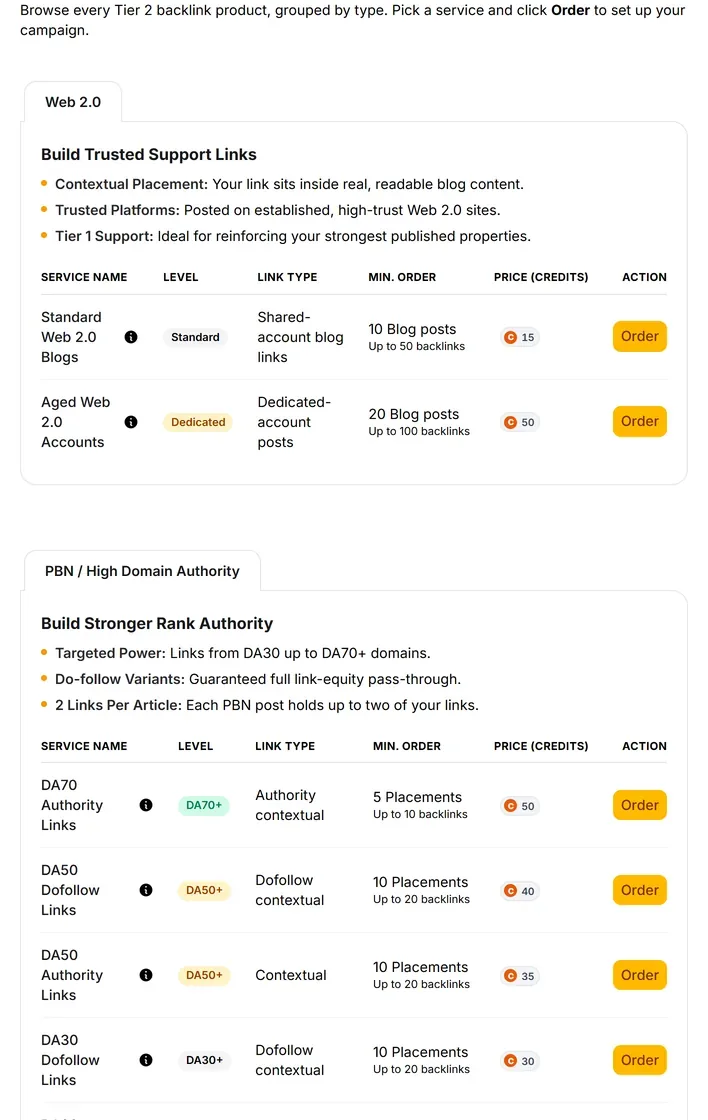
- Three at $17.20, then $23.20, $34.40, $51.60 and $57.20 — light starter through flagship blast.
- What one campaign unit is
- A single order that builds up to 100 links across many platform types.
- Starter and flagship
- The starter size is $17.20. The flagship is $57.20. Every bundle prints its cost on its own Order button.
- Platform mix
- Blogs, article submissions, wikis, profiles, forums, bookmarks and more. Composed by the engine, not selected line by line.
- Where they point
- Tier 1 pages only — your articles, releases, guest posts and citations. Site and blog excluded by design.
- Anchor text
- Pooled from tracked rankings and Search Console, or typed by you. Spread across the links.
- Campaign extras
- Indexer tiers one to three across the campaign. Captcha backup, a second solving pass that completes roughly 130% more placements.
- Indexing
- Not automatic. Indexer tiers are a paid extra.
- Reporting
- One branded report per publish run.
- Cancellation
- Cancel while the vendor still has it pending and credits refund.
- Minimum order
- We don't publish one. Quantity rules come from the provider's live catalogue and show on the form.
- Delivery date
- We don't publish one, for this or anything else we sell. The order status moves through its steps in the report.
Backlink figures are ceilings, not promises. Dollar figures use the same credit rate the pricing page converts at, and buying credits in bulk lowers it. Catalogue prices come from the provider and can move, so the Order button is the price of record.
What it costs to find out
See what each of the seven campaign sizes costs, free.
The account is free and needs no card. Every bundle's cost sits on its own row. Pick the size, then aim it at a page you already own.
Creating the account is free. Not a trial that takes your card "for verification" — no card at all, and no call with anyone.
And nothing expires on a timer. Credits sit in the account until you spend them.
When you're ready to spend
$0.35–$0.50
per credit, improving with the volume you commit to
See the full pricing page →What you are not signing
No contract, no minimum, no quote and no call. Buy credits monthly if the volume suits you, or buy a block once and owe nothing after it.
Every deliverable in the platform prints its credit cost on the button that spends it, so you always price the work before you run it.
No card required. See every tool and every price before you spend anything.
Before you ask
The questions we'd ask before pointing this at a client.
- What does a campaign do for my SEO?
- It gives a page you already paid for a whole layer of links instead of a handful. Google finds and re-visits a page by following links to it, and almost nothing links to your guest post today. One order builds up to 100 links behind it, from many platform types.
- Why can't I point a campaign at my own website?
- Because campaign volume amplifies whatever you aim at, and these links are lower-trust. Aimed at a money site that's the footprint you spend years explaining. The site and blog are blocked on the form. Point it at Tier 1 only.
- Will a hundred links move my rankings?
- We won't promise that, and nobody honestly can. What the campaign does is get a link you already own crawled and keep its value moving, with a layer that doesn't look like one order form. That's an input to a ranking, not a ranking.
- What's actually in the mix?
- Blogs, article submissions, wikis, profiles, forums, bookmarks and other platform types, composed by the campaign engine. We don't publish a per-platform breakdown, because the composition belongs to the provider and it moves.
- Is the flagship campaign always better than a DA30 order?
- It's bigger and more varied, which isn't automatically better. A flagship guest post with nothing behind it can use a broad push. A page that already has one usually wants graded weight instead.
- Do all hundred links get built?
- Up to a hundred. Captchas, moderation and platform changes mean some placements fail, which is why captcha backup exists and why the report shows what landed.
- Do the links get indexed automatically?
- No, and nothing indexes itself. Indexer tiers can be applied across the whole campaign.
- Isn't firing a hundred mixed links just spam?
- Aimed at a money site, yes, and that's why the money site isn't selectable. Aimed at a page a real publisher already vouched for, it's a support layer under a link you paid for.
- What's the minimum order?
- We don't publish one. Quantity rules come from the provider's live catalogue on the order form.
- What does a campaign cost?
- Seven bundles, from $17.20 at the starter end to $57.20 at the flagship. Extras like the indexer and the content packs carry their own costs, and the total prints before anything is charged.
One order. Many platform types.
All of it pointing at the page you paid for.
A layer made of one link type compounds the wrong signal. A varied layer behind a trusted page gives rankings something cleaner to climb on.
Start with a single-product order against a real Tier 1 URL if you want a baseline. Escalate to a campaign when a report says the page can use the mix.
Either way, the target is a page you already bought. Never the money site.
P.S. — Create the free account. Open the campaign tab. Read all seven prices. Pick a Tier 1 target the form will actually allow. Then decide, before anything is charged.
No card required. See every tool and every price before you spend anything.
The rest of Tier 2 Backlinks