Pro AI Writer · Product Review
A review search is nearly a sale. Rank for it with a real verdict.
Google answers that search with pros, drawbacks and a decision. A page that hedges is the wrong shape for it.
- A review search wants a verdict. — This format builds the outline toward one, so the page is the right shape.
- It reads the reviews already ranking. — The criteria they judge on, and the objections they raise.
- Cons is a section, not a maybe. — It exists in the outline before any prose does, so it can't quietly evaporate.
- The verdict is written last. — From the evidence above it, not decided first and defended downwards.
- Depth is scored on its own bar. — Five hundred words of specifications is long. It isn't a review.
- The one input we can't supply. — It has not used the product. Paste what you know and the draft builds around it.
- A scanner, not a promise. — It rewrites machine-sounding lines. It won't claim a detector pass.
- A draft is $2. — Headline options are 40¢. Publishing is free.
A review that commits,
on the search that comes before the card.
Nobody searches "[product] review" for fun.
They have almost decided, and they want a verdict.
That search sits closer to a sale than anything else you rank for.
Now look at what Google shows for it. Pros, drawbacks, a verdict.
A page with no drawbacks in it is not a review, so it does not compete.
This one writes the drawbacks and answers the objections the ranking reviews raise.
No card required. See every tool and every price before you spend anything.
Read one cons section and decide from there.
Pick a product you have strong opinions about. Run a draft. Skip to the drawbacks. That paragraph is the entire evaluation.
No card required. See every tool and every price before you spend anything.
How a review gets built
It reads the reviews that already rank.
Most reviews are written backwards. The verdict gets decided first, then the evidence is arranged to support it.
- 01
Give it the product, the keyword, and pick Product Review
A real format setting, not a line added to a prompt. It changes the outline, the headings and the scoring. Depth carries more weight here than coverage.
- 02
It reads the reviews ranking right now
The live top ten, checked for the criteria those reviewers judge on and the objections they raise. The outline is built around that objection list.
- 03
Pros and cons are separated before any prose exists
Both are structural sections. A section that exists before the writing starts can't disappear during it.
- 04
The company brief goes in
Positioning, terminology and topics to avoid, from the client's own site. Nothing gets credited to them that isn't theirs.
- 05
The verdict is written last
Who should buy it, who shouldn't, and why. Plain enough that a reader can act without scrolling back up.
- 06
Score, scan, publish
A hundred-point score with the missing terms named, then the AI-likeness scan, then one click to the client's blog.
What you end up holding
A review that commits, ready to publish.
Picture the review search your client has been losing for two years. You open the draft and scroll past the pros.
- The article
- Pros, cons and a verdict, formatted and headed, in that order.
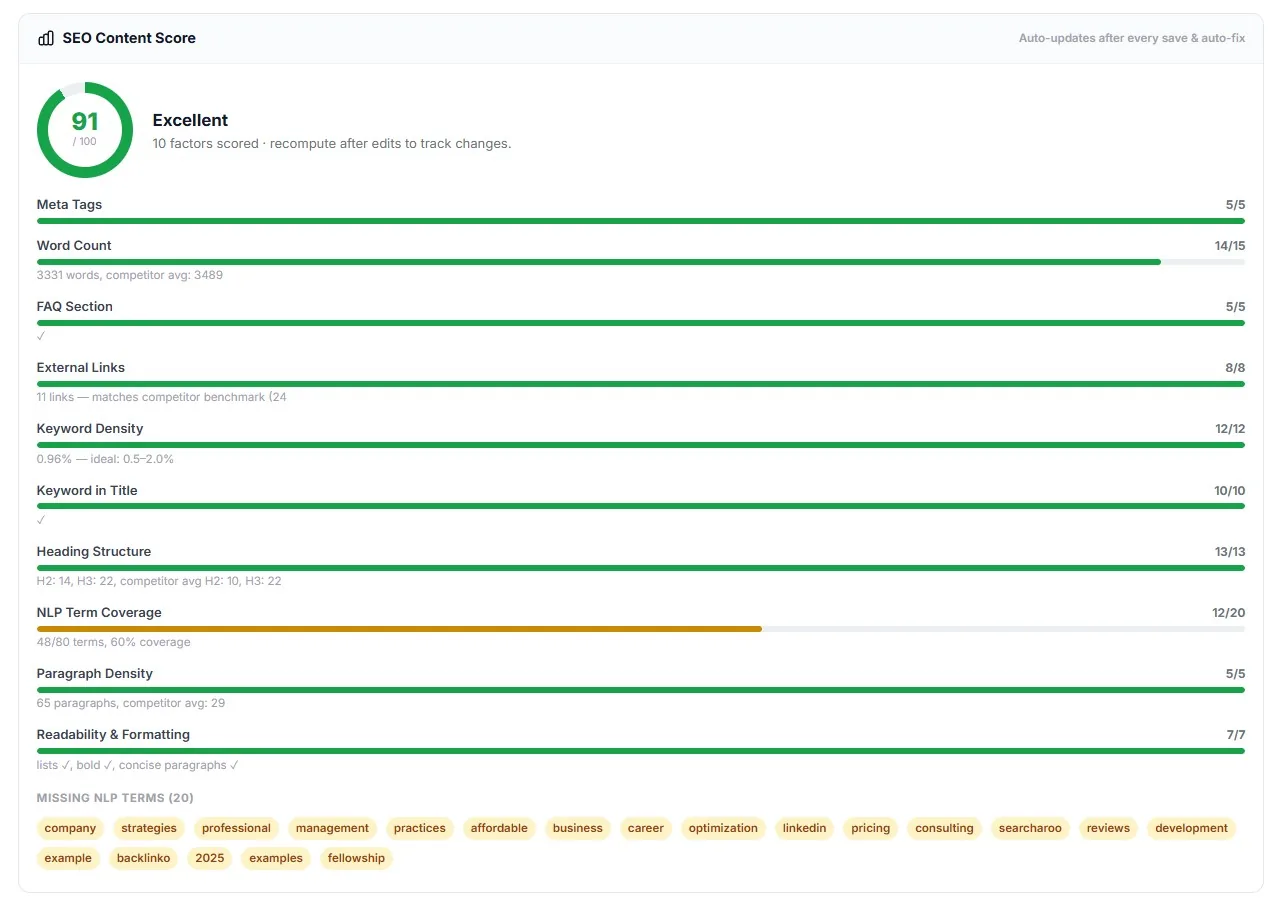
- A 100-point content score
- Broken down by category. Depth is the row that matters on a review.
- An AI-likeness report
- What the scanner flagged and rewrote. It cannot guarantee a pass on any commercial detector, and says so on screen.
- Headline options
- A batch of alternatives for 40¢. On a review the headline is where the verdict leaks, and that leak earns the click.
- A featured image
- Generated from the article's own opening, not from the title. 80¢ to redo it.
- Meta title and description
- Written from the finished draft. No review or rating structured data.
A draft is $2. Nothing per word.
Charged once. Headline options are 40¢. Publishing is free. Credits sit there until you spend them.
No card required. See every tool and every price before you spend anything.
The countable part
What it costs, and what it actually does.
- Format
- Product Review — one of eleven, set per article.
- The search it matches
- "[Product] review", "is [product] worth it", "[product] pros and cons". A buyer who has almost decided.
- Full draft
- $2.
- Headline batch
- 40¢.
- Featured image redo
- 80¢.
- Cost per finished review
- $2.40, headline options included.
- Publish to blog
- Included. WordPress or stored credentials.
- Company brief
- $2, once per client. Refunded if it fails.
- Failed run
- Refunded automatically. You don't pay for a broken draft.
- Research
- The live top ten for the keyword, checked for the criteria those reviewers judge on and the objections they raise.
- Structure
- Pros, cons and a verdict are outline sections, not optional paragraphs. The verdict is generated after both.
- Word count
- Auto-targets the competitor average plus 10%, minimum 1,500 words. Or set your own, up to 8,000.
- Scoring
- 100 points across 10 weighted factors, plus an AI-likeness scan.
- Hands-on testing
- None. It has not used the product. First-hand experience is yours to paste into the instructions.
- Structured data
- None, including review, rating and product markup. Meta title and description only.
- Internal links
- Suggested at publish time against the client's existing posts. Not inserted during generation.
- Delivery date
- We don't publish one. A made-up estimate breaks a promise faster than silence does.
Credit costs are the live values on your account, printed on the button that spends them. Dollar figures come off the same rate card that runs checkout.
What it costs to find out
Price the product review before a word gets written.
Adding the client, the product and the angle costs nothing. A draft is $2, and the button says so before it runs.
Creating the account is free. Not a trial that takes your card "for verification" — no card at all, and no call with anyone.
And nothing expires on a timer. Credits sit in the account until you spend them.
When you're ready to spend
$0.35–$0.50
per credit, improving with the volume you commit to
See the full pricing page →What you are not signing
No contract, no minimum, no quote and no call. Buy credits monthly if the volume suits you, or buy a block once and owe nothing after it.
Every deliverable in the platform prints its credit cost on the button that spends it, so you always price the work before you run it.
No card required. See every tool and every price before you spend anything.
Before you ask
The questions we'd ask before pointing this at a client.
- What does a product review do for my search rankings?
- It puts your client on the search a buyer runs last. Google answers that search with pros, drawbacks and a verdict, so a page in another shape isn't in the running. This writes that page, judged on the criteria the ranking reviews use.
- Google wants evidence of first-hand use. This hasn't used the product.
- Correct, and that's the honest problem with every AI review tool, this one included. Neither has most of what currently ranks. Your own hands-on notes go into the instructions, and that is the part nobody else can write.
- Will this rank my page?
- We won't promise a ranking, because nobody honestly can. What it does is make the page eligible to compete: the right shape, real drawbacks, and a verdict on the criteria the ranking reviews judge on. Links and the rest of the site decide the rest.
- Will it criticise a product my client sells?
- If the research supports a criticism, yes. That's the point of the format — a review that commits outperforms one that hedges, because the reader is looking for someone to trust.
- Does it produce review or rating markup?
- No. It writes a meta title and a meta description, and that's the whole of its structured output.
- Will it pass an AI detector?
- We won't promise that, and anyone who does is guessing. The scanner is local. It rewrites machine-sounding passages and reports what it changed, and it cannot guarantee a pass on any commercial detector.
- Where does it publish?
- WordPress, or any blog reachable with stored login credentials. Internal link suggestions are generated at publish time, against the client's existing posts.
- What does a review actually cost?
- $2 for a full draft. Headline options are 40¢, so a finished review is $2.40. Publishing is free.
A review that commits,
on the search that comes before the card.
Here's the part that has nothing to do with us. That review search runs every month whether your client shows up or not. Whoever owns it collects the buyers and the brand recall. Nobody is holding the slot for you.
So picture six months out. Either the review is still item nine on a content calendar nobody has opened since March. Or your client owns the page a buyer reads with a card already out.
Run one on a product you have opinions about. Read the cons section first. That paragraph is the whole decision.
P.S. — The fear isn't the $2. It's publishing something under a client's name that reads like every other AI review in the results. So read the drawbacks first, every time. The paragraph nobody else can write is the one where you say what happened when you used it. Create the account, no card, and go read one cons section.
No card required. See every tool and every price before you spend anything.
The rest of Pro AI Writer