Tools · ChatGPT Mentions
More buying research starts in AI answers. See whether those answers cite you.
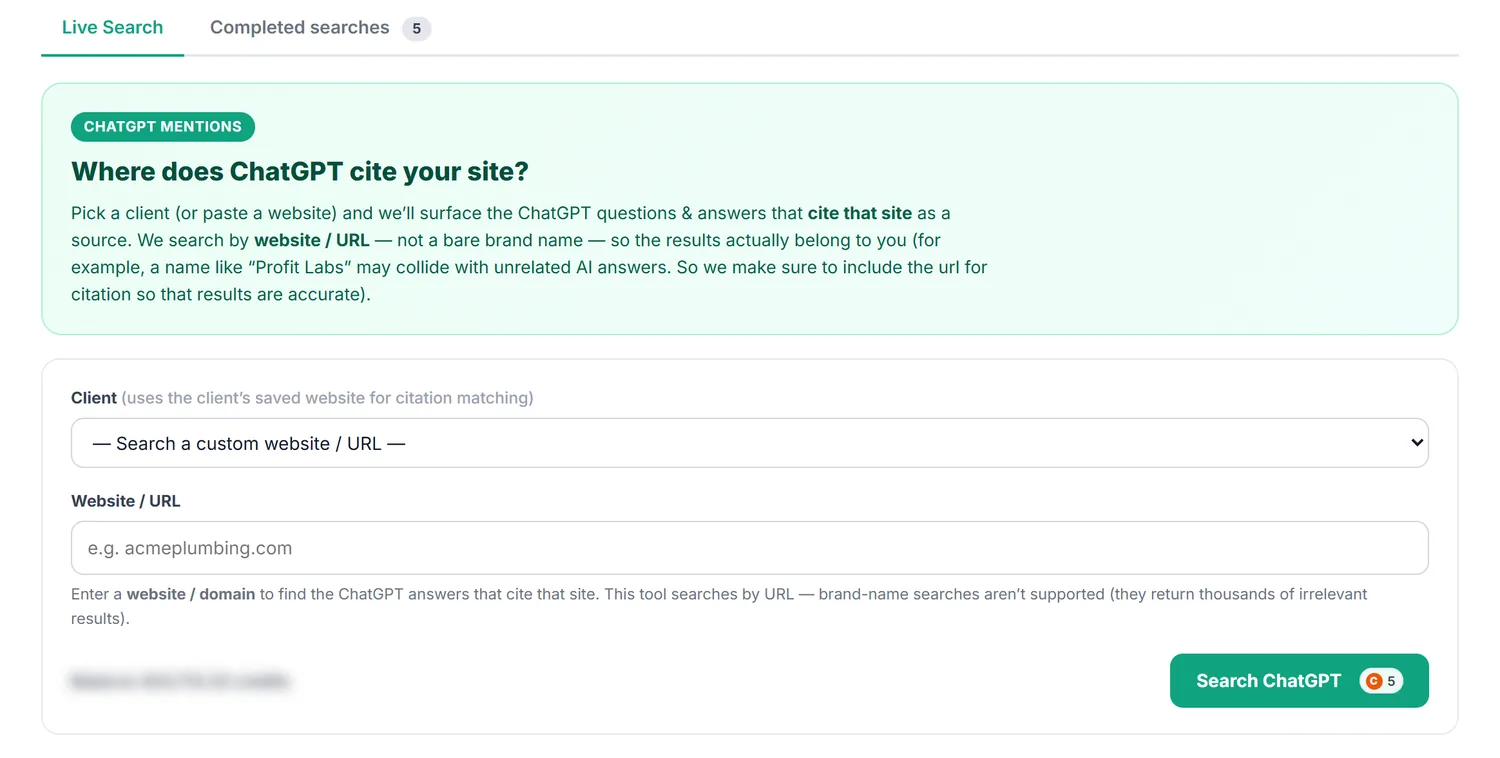
ChatGPT names sources when it answers. This shows you the questions where your pages are one of them. $2 a search.
- It searches by website and URL. — So the hits belong to you, not to a similar brand name.
- You see the questions, not a score. — The actual asks where your pages were used as a source.
- Up to a thousand rows. — Questions and answers that cite the site you entered.
- $2 a search. — The price prints on the button before it runs.
- It measures. It does not promise. — No tool can make an AI answer cite you, and we won't claim one.
- Not a rank tracker. — This is citation presence in AI answers. A different surface.
- Not Google's AI Overview. — That is a separate free tab on Rank Tracker checks.
- Same account as the work. — Find a gap, then write or build links against it.
See which ChatGPT answers cite your site.
Searched by URL, not by brand name.
People used to open ten blue links. Many now read one answer instead.
That answer names the sources it was built from.
Being one of those sources is the new version of ranking.
Nobody can tell you if you are, because it never shows in your analytics.
So check. Paste the site and read the list.
An empty list is an answer too.
No card required. See every tool and every price before you spend anything.
Why nobody knows where they stand here
AI answers send no referrer. You can't see them in your analytics.
A search ranking is easy to check. You look.
An AI citation is invisible.
Someone asks who to hire, gets an answer naming four sources, and picks one.
None of that shows up in your traffic reports.
So most businesses have never checked whether they appear at all.
This tool checks. It searches by your website address, not your brand name.
That matters, because brand-name matching returns everyone with a similar name.
Now the honest part. This measures. It cannot make an answer cite you.
Nothing can, and anyone selling you that is guessing.
What you get is the list, and the list tells you what to publish next.
Check one client site before you guess.
Free account. Paste the site. Find out whether AI answers already cite them.
No card required. See every tool and every price before you spend anything.
How it works
Paste the site. Read the citations.
One search, and a list of answers that name your pages.
- 01
Pick the client
It fills in their saved website. Or paste any website or URL.
- 02
Run the search
$2, printed on the button before it spends.
- 03
Read the rows
The questions asked, and the answers that cite that site.
- 04
Read the empty rows too
No citations is a finding. It tells you the surface is open.
- 05
Keep the result
Completed searches are stored and reopen without charging again.
- 06
Act on the gaps
Publish, syndicate or build links on the topics where you're missing.
What you get
A list of AI answers that name you.
Or an empty list, which is also an answer.
- Citation rows
- Up to 1,000 questions and answers citing the URL you entered.
- The questions themselves
- What people asked to get that answer. That's your topic list.
- URL-scoped results
- Matched on the website, not on a fuzzy brand name.
- A kept search
- Reopen a completed search later without paying for it twice.
$2 a search. Up to a thousand rows.
Completed searches are kept and can be reopened without paying again. Credits don't expire.
No card required. See every tool and every price before you spend anything.
The facts
Cost and scope.
- Cost
- $2 per search.
- Match
- Website and URL — not brand name alone.
- Rows
- Up to 1,000 per search.
- Inputs
- A saved client's website, or any website or URL you paste.
- Retention
- Completed searches are kept and replay without charging again.
- What it does not do
- It does not influence what ChatGPT cites, and no tool does. It reports what is already there.
- Not included
- Google AI Overview. That's a separate free tab on Rank Tracker checks.
What it costs to find out
See what one ChatGPT citation search costs before it runs.
The account is free and takes no card. The search costs $2, and that figure sits on the button before you press it.
Creating the account is free. Not a trial that takes your card "for verification" — no card at all, and no call with anyone.
And nothing expires on a timer. Credits sit in the account until you spend them.
When you're ready to spend
$0.35–$0.50
per credit, improving with the volume you commit to
See the full pricing page →What you are not signing
No contract, no minimum, no quote and no call. Buy credits monthly if the volume suits you, or buy a block once and owe nothing after it.
Every deliverable in the platform prints its credit cost on the button that spends it, so you always price the work before you run it.
No card required. See every tool and every price before you spend anything.
Before you ask
The questions we'd ask before pointing this at a client.
- Why does it matter whether AI answers cite me?
- Because a growing share of research happens there. Someone asks which company to use, gets an answer that names a handful of sources, and works from that shortlist. If your pages are never a source, you're not in the running for that person, and no ranking report will tell you.
- How is this different from tracking rankings?
- A rank tracker tells you where your page sits in a list of blue links. This tells you whether your page is being used as a source inside a written answer. Two different surfaces, and a site can do well on one and not the other.
- Will this get me cited by ChatGPT?
- No, and be careful with anyone who says their tool will. This measures. It shows which answers already cite your site and which questions they came from, so you know what to publish or build links toward. What the answer names is not something we control.
- Why search by URL and not by brand name?
- Brand matches are noisy. Half the results belong to a company with a similar name. Matching on the website means every row you read is genuinely yours.
- Is this the same as AI Overview tracking?
- No. Google's AI Overview comes free with Rank Tracker checks. This tool is about ChatGPT answer citations, which is a separate surface and a paid search.
- What does it cost?
- $2 per search, shown on the button before it runs. Completed searches are kept, so reopening one later costs nothing.
- What if it returns nothing?
- That happens, and it's still worth knowing. It means the surface is wide open for that client, and it tells you the work hasn't been done yet rather than leaving you to assume it has.
See which ChatGPT answers cite your site.
Searched by URL, not by brand name.
Here's the part that has nothing to do with us. Somebody is being named in those answers for your client's category. Every month that carries on, they collect the buyers who never open a search result at all.
You can't fix a gap you haven't looked at.
Paste one client's website. Read the rows. Then decide what to publish next.
P.S. — The account is free and takes no card. The search is $2, printed on the button before it spends. Check one site today, even if the list comes back empty. Especially if it comes back empty.
No card required. See every tool and every price before you spend anything.
The rest of Research Tools