Local SEO Backlinks
Make Google sure who and where you are. Then see where you rank, street by street.
The map pack ranks the Google Business Profile, not your website. A grid scan draws where that profile drops out — $8.
- Find the streets you're missing from. — A grid samples map-pack position at up to 225 points and colours it in.
- About 4¢ per sampled point. — A scan is $8. It's the cheapest thing in this family, on purpose.
- Details that disagree cost you rank. — Thirty listings built from one record give Google one clear answer.
- The map pack ranks the Profile. — So these links aim at the Google Business Profile, through its CID URL.
- Relevance across the whole service area. — A published map with keyword-tagged pins in every town you serve.
- Nothing indexes itself. — Citation farms sell automatic daily index submission. Here it's one click per row, then tracked.
- One deliverable is a photograph. — The Profile links come back as a screenshot, not a link, on purpose.
- Scan again and compare. — Grid history is kept, so the second scan is a before-and-after.
Make Google sure who and where the business is,
and see where it ranks, street by street.
Two things decide who shows up in the map pack.
First: can Google tell who and where this business is?
When it isn't sure, it quietly discounts that business.
Second: does anything point at the Google Business Profile?
The profile is what the map pack ranks. Not your website.
Blog posts and homepage links answer neither question. So measure first.
No card required. See every tool and every price before you spend anything.
Why local budgets don't move the map pack
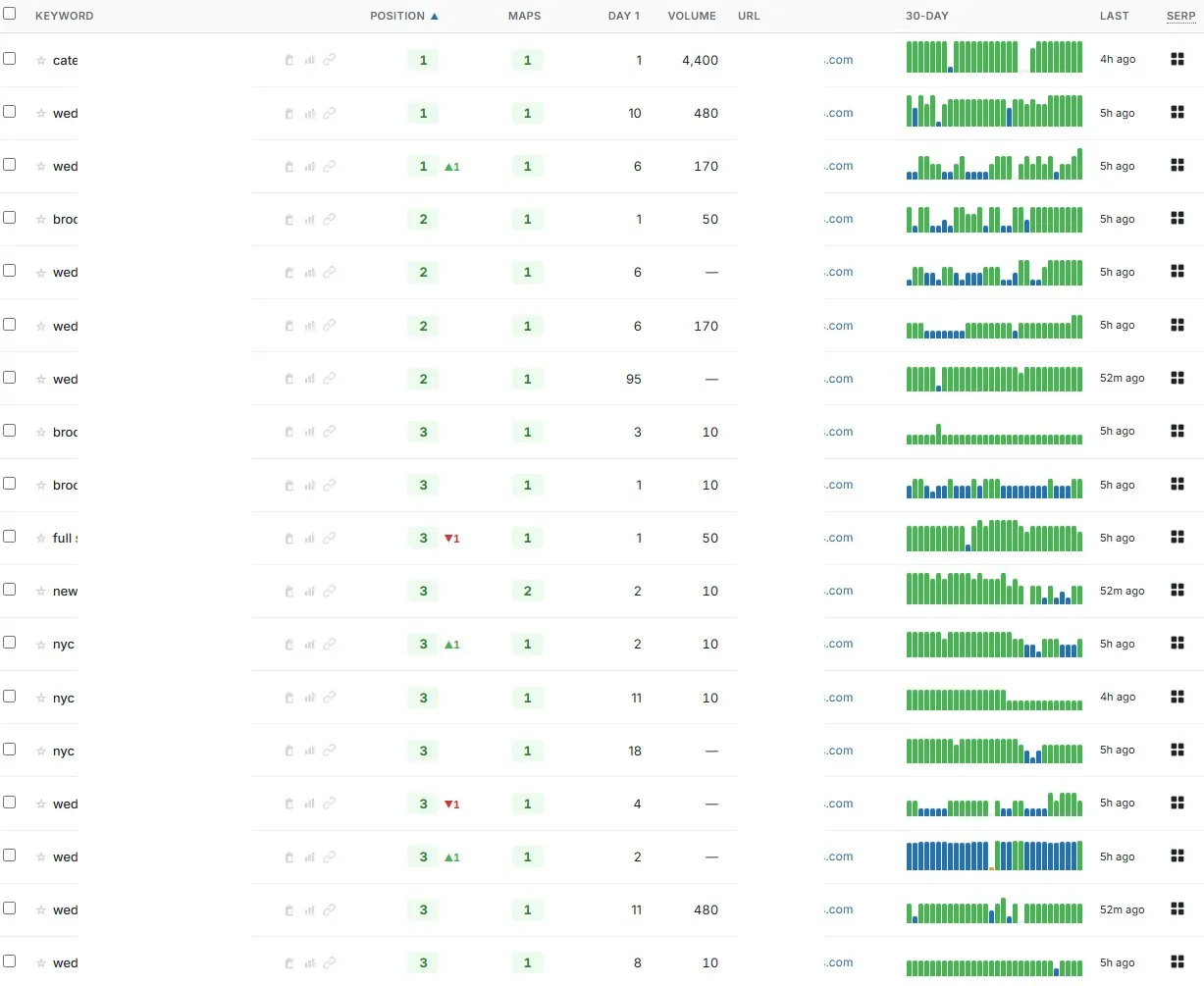
Local search grades two things. Most local budgets touch neither.
Blog posts and links to the homepage. That's what the money buys.
Both are real work. Neither one is what the map pack ranks.
The map pack ranks the Business Profile, and almost every local link product aims at a website instead.
The second one is worse, because it fails in silence. The suite number changed. The tracking number got swapped in.
A dozen directories still carry the old ones. Google can't be sure who this business is, so it quietly trusts it less.
No notification. No penalty message. Nothing to appeal. So you write more content, nothing moves, and you decide local SEO doesn't work in your industry.
Now the honest part. None of these four products buys a map-pack position. One is a measurement. Another ships a screenshot on purpose.
See where the profile drops out before you pay to fix it.
No card and no minimum. Set up the client record, drop a grid over the service area, and read the price on the scan button.
No card required. See every tool and every price before you spend anything.
The mechanism
Four layers, in the order you should buy them.
Measure first. Then fix the data Google reads.
- 01
First, find out where you actually rank
A grid samples map-pack position across the whole service area instead of at one point. Ranking first at your own address and eleventh four miles out looks like ranking first in a normal check.
- 02
Then make the details agree with each other
Thirty relevant local and niche listings, built from the name, address and phone read straight out of the client record. Nobody retypes the address thirty times, so nothing drifts on listing nineteen.
- 03
Then get those live URLs in front of Google
The listings come back as real pages. One click per row from the report, then tracked to indexed.
- 04
Point the links at the Profile, not the homepage
High-metric, subject-matched placements aimed at the Google Business Profile via its CID URL. The article inside can be written from the client's company brief, built by crawling their own site.
- 05
Then cover the towns you actually drive to
Radius Booster geocodes the location and radius, then drops keyword-tagged pins across every target area. You get a live map URL, the KML file and a branded PDF.
- 06
Scan the grid again and compare the two pictures
The instrument that showed you where coverage stopped shows whether it moved. History is kept against the client record, so the before-and-after is an artefact you hand over.
What you end up holding
Live URLs, a screenshot set, and a map you can embed.
Picture the next review call. Two grids side by side on the screen, and the grey has pulled back toward the edges.
- 30 live directory URLs, plus the logins
- Clickable and indexable, all carrying one identical set of details, with source, URL, status, username, password and email for each one.
- Screenshots of the Business Profile placements
- In the product's own words: "The deliverable is a screenshot, not a link. We do that deliberately, to avoid spam footprints and keep the network's domain metrics clean and authoritative."
- A published service-area map
- A live map URL plus the KML file, with keyword-tagged pins across the whole radius. An embeddable asset, not a document about one.
- A branded PDF, one click from Google Drive
- Your logo, every live URL, the keyword table, and a full run history filed against the client permanently.
- The grid heatmap, kept as history
- The before-and-after instrument. It makes the problem obvious to someone who doesn't do this for a living.
A scan is $8. Nothing in this family is a retainer.
That's what it costs to measure. The thirty-listing citation pack is $56, charged once.
No card required. See every tool and every price before you spend anything.
The countable facts
What each of the four layers is.
- Map grid scans
- Map-pack position sampled across the service area and drawn as a heatmap, from 25 points up to 225. $8 a scan, charged per run. Google only.
- Local Citations
- 30 live niche and local directory listings per order, details read from the client record, real indexable URLs plus per-listing credentials in a branded report. $56 an order. One order at a time.
- Local PBN Links
- Charged per link on high-metric, subject-matched properties, aimed at the Google Business Profile via a required CID URL. The price depends on the property you pick, so it's shown on the order screen before you confirm. The deliverable is a screenshot.
- Radius Booster
- Geocoded location and radius, up to nine keyword layers, pins across every resolved target area, a live map URL, a KML file and a branded PDF. Building is free; $16 lands on publish.
- Indexing
- Live citation URLs and radius maps: one click per row from the report, then tracked to indexed. Screenshot deliverables are labelled as not indexable, because they aren't.
- What none of it is
- Not a position promise. Not competitor tracking.
- What a client needs
- A complete street address and a Business Profile. Citation building and radius maps can't run without a real location, and no address gets invented so a national brand looks local.
- Refunds
- Credits are charged on acceptance and refunded automatically when an order can't be placed or a map can't be published.
- Delivery date
- We don't publish one, for this or anything else we sell. There's no delivery data worth quoting, and an invented estimate breaks expectations faster than silence does.
Dollar figures here are the live costs on your account, quoted at the 1,000-credit plan rate. Buy in smaller amounts and they cost a little more; the pricing page shows the whole curve, and the button always prints what it is about to spend.
What it costs to find out
Price all four local layers before you buy any of them.
The account takes no card. Add the client's Business Profile, size a grid over the service area, and read the cost printed on the button.
Creating the account is free. Not a trial that takes your card "for verification" — no card at all, and no call with anyone.
And nothing expires on a timer. Credits sit in the account until you spend them.
When you're ready to spend
$0.35–$0.50
per credit, improving with the volume you commit to
See the full pricing page →What you are not signing
No contract, no minimum, no quote and no call. Buy credits monthly if the volume suits you, or buy a block once and owe nothing after it.
Every deliverable in the platform prints its credit cost on the button that spends it, so you always price the work before you run it.
No card required. See every tool and every price before you spend anything.
Before you ask
The questions we'd ask before pointing this at a client.
- So what am I actually buying here?
- Two things Google needs before it will rank a business locally, plus the instrument that tells you which one is missing. It has to be sure who and where the business is, and something has to point at its Business Profile.
- Will this get my client into the map pack?
- No honest vendor can promise that, and we won't. These four layers make the business easy to identify and visible across the area. One of them is only a measurement.
- Why don't blog posts and homepage links move the map pack?
- Because they point at the website, and the map pack ranks the Business Profile. Content and website links feed local organic results, which is a different set of positions on the same page.
- What does the grid scan tell me, and why run it first?
- Where the map pack drops the profile, street by street. One average position hides every street where it's missing. Run it first so you know which towns need the work.
- Why do the Business Profile links come back as screenshots?
- Publishing those URLs would wreck the network. The product ships a screenshot on purpose, not a link.
- Why aim links at the Business Profile rather than my website?
- Because they rank different things. Your website's authority feeds local organic results. The Profile is what the map pack ranks.
- How do you know my business details are right?
- They come out of the client record — the name, address, phone, website, Business Profile, Bing Places and social profiles you entered once.
- Will the citations get indexed?
- They're live, indexable URLs, and from the report you submit them one click per row, then we track each one until it comes back indexed.
- Can I do this for a national or e-commerce business?
- The citations and the Profile links, yes, if there's a complete street address and a real Business Profile behind them. The radius map is inherently local.
Make Google sure who and where the business is,
and see where it ranks, street by street.
Here's the part that has nothing to do with us. The competitor two towns over is being handed those jobs today, on proximity alone. That gap doesn't hold still.
So picture this account six months out. In the first version, one flattering number in a report and a client who can't say why Tuesdays are quiet.
In the second, two grids side by side on a screen share — same map, six months apart, the grey pulling back. Thirty live listings and a published map behind the change.
Start with the scan. If the coverage already reaches every town they serve, you don't need us and you've saved an order.
P.S. — The last three people who sold you local SEO showed a dashboard, not an outcome. Start with the scan — $8. It might tell you not to buy the rest.
No card required. See every tool and every price before you spend anything.
The rest of it