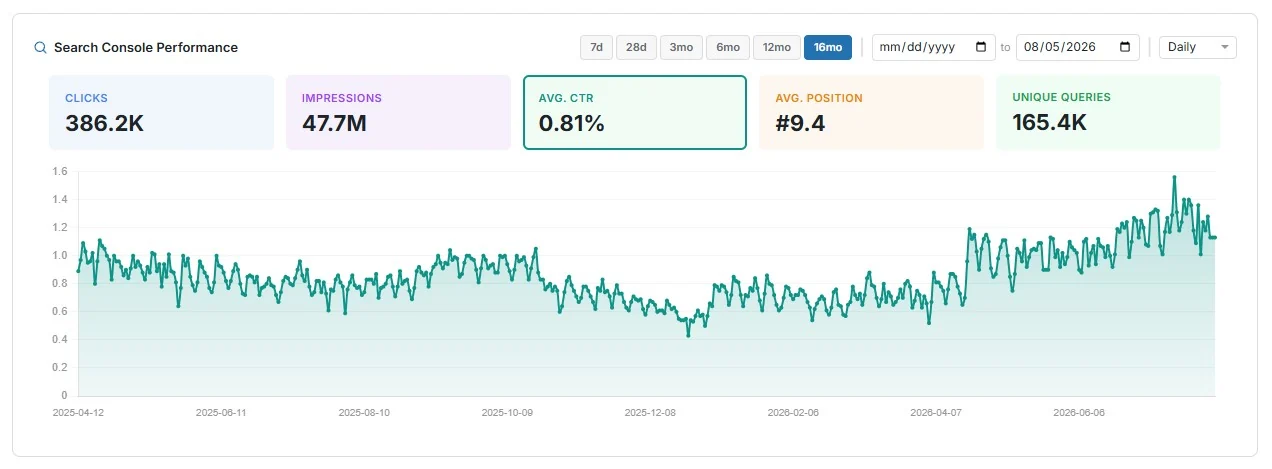
One client shows up in 165,400 different Google searches. Nobody can plan a list that long.
This is what happens when Google decides a site is the expert on a topic. It stops showing you for a few keywords. It starts showing you for questions you never thought of.
No card · No call · Every button shows its price before it spends
Start here
Nobody picked 165,400 keywords.
Look at that number again. 165,400.
No one made a list that long. You can't. There is no plan with 165,400 rows in it.
So where did it come from?
Google decided that site was the expert on a topic.
Once Google believes that, it stops matching you to your few keywords. It starts showing you for all the questions around that topic.
People in SEO call this topical authority. It just means Google thinks you own the subject.
Here is the good part. You can teach Google that on purpose.
Most agencies never do. So let me show you the step they skip.
The step almost everyone skips
Most agencies write the post. Then they stop.
You know how this goes.
Someone writes a blog post. It is good.
It goes live on a Tuesday. Maybe someone shares it once.
Then everyone moves on to the next post.
And that is it. Nothing else ever happens to it.
Look at the invoice and you can see why. It says four blog posts. So four blog posts is what gets sent.
The job ends at the word publish.
That post now sits on one website. It says one thing. One time.
Google barely learned anything from it.
And it is not your fault. Nobody sells the second half. It never got scoped, so it never got done.
The rule that changes it
Google does not learn from your site. It learns from other sites.
This is the part worth writing down.
Google does not decide what you are good at by reading your website.
It decides by reading what other websites say about you.
Your own site saying it is just you talking about yourself.
135+ other sites saying it is proof.
We call it the Repeat Rule. Say it once and it is a claim. Say it in 135+ places and Google starts treating it as a fact.
So we take one post you already wrote. We publish it across the network. Every copy is about the same topic. Every copy links back to you.
Google reads that same lesson 135+ times.
One thing to be clear about. We are not trying to rank the post we publish.
We are teaching Google that the topic belongs to your client.
When Google believes that, the pages they already have on that topic can move. Not for one keyword. For a lot of them.
That is how a site ends up with a number like 165,400.
Give it a test drive.
The account is free. No card. Set up a client and open a draft. The price is printed on the button. Nothing is charged until you press it.
Saving a draft costs nothing
The part other companies hide
These sites will not send you visitors. Here is why that is fine.
I want to tell you the worst part before you buy.
The sites in this network get almost no traffic.
We checked our own. Here is what we found.
- Where the links sit
- On subdomains. The middle one scores 153 out of 1000.
- The main domains
- The middle one scores 224 out of 1000. Only 14% get past 300.
- Visitors per month
- The middle site gets 3.4 US visits a month. Only 15% get past 1,000.
Other companies sell these same sites and call them “premium publishers.” Same sites. They hope you do not check.
So why would you buy this?
Because readers were never the point. You are not buying visitors. You are buying proof.
Google does not need a busy site to learn from it. It needs to see the same topic again and again, all pointing at you.
Do you want real readers? Then buy a guest post instead. You pick the site. You see its traffic first. Same account, same credits. It is just not this.
How it works
How one post becomes 135+.
You do step one. We do the rest.
-
You send us one post you already published
Paste the link. It has to be a blog post. Service and product pages get turned down. Pick the topic you want your client known for. That topic is what goes everywhere. So pick it carefully. It is the real product.
-
We take out the old contact details
We do this for every client. Old addresses. Old phone numbers. Leftover code from anywhere the post has been before. Two sets of details is worse than none.
-
Local clients get their details put back
Name, address, phone, profile links and a map. All pulled from their record. National clients and online stores get nothing added. We will not make up an address for a business that does not have one.
-
It goes live, then it locks
The network pulls from a live feed every day. The moment it starts, the post locks. That is the only way all 135+ copies stay the same as each other.
-
The copies come back and we count them
You get a numbered list of every live link. We keep it forever. The count never goes down.
-
You send them to Google
One click per row. It is not automatic and we will not say it is. You click. Then we watch it until Google has it. A copy Google never saw teaches it nothing.
More of our own accounts
What this looks like on a chart.
These are not a promise. They are what the accounts running this actually do. Every panel is read from the client's own Google Analytics or Search Console, inside our platform.
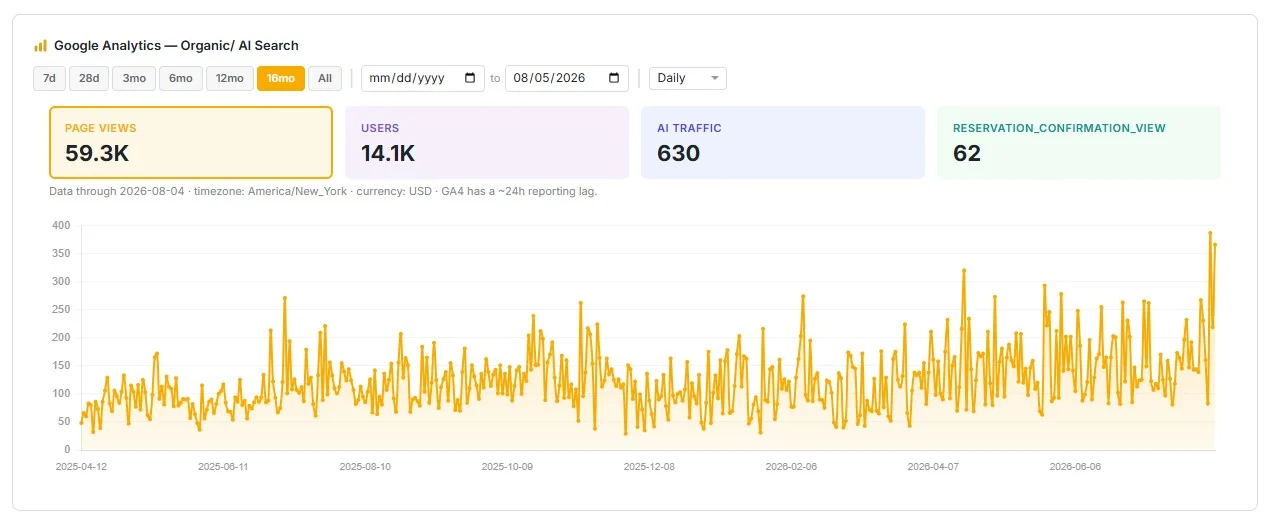
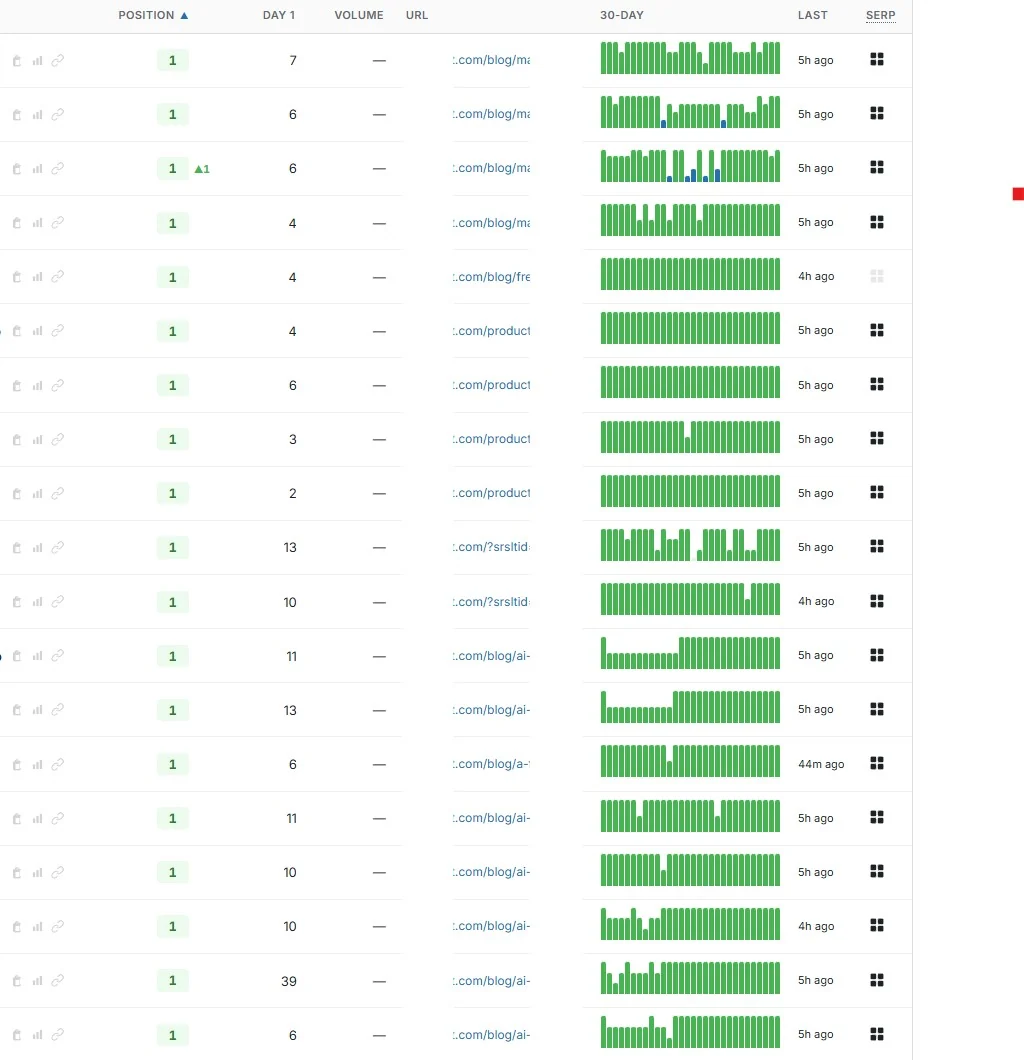
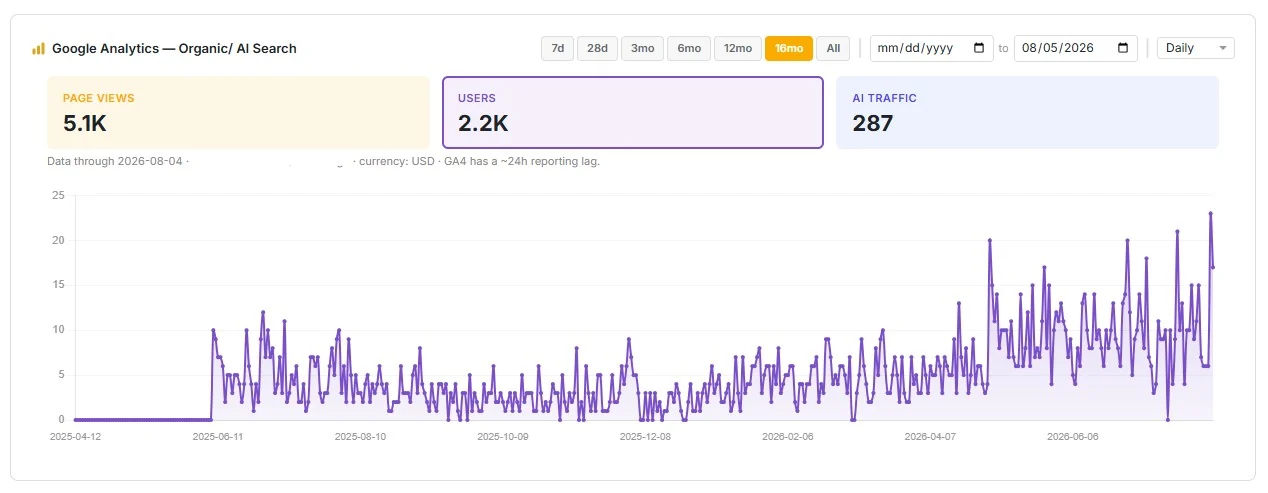
Read this straight. These are our own client accounts. They are not customer results and they are not a promise about your site. Syndication runs in 42 of our 45 programs, so it is one part of every chart here. But guest posts, press releases and Tier 2 are in there too. We will not pretend one line on a chart belongs to one product. And notice what these charts show: the client's traffic going up. Not the network's traffic. The network mostly has none. That is the whole point of the section above.
What you get back
Something you can show on a client call.
Picture your next client call. You share your screen. The order loads. The list is right there.
You do not have to explain it. You just scroll.
-
The same post on 135+ sites
Every copy on your topic. Every copy links back to your client.
-
A list of every single link
Numbered, newest first. A branded PDF too. Kept forever, on our side.
-
A map and details on local copies
Local clients only. Their location travels with the post.
-
A status you can read at a glance
Published. Pending. Needs Review. Nothing fails quietly.
-
One-click indexing per row
You send it. We watch it until Google has it.
The countable part
The numbers, with nothing rounded up.
- Cost
- 100 credits per campaign, flat. About $35 to $50, depending on your credit rate. Saving a draft costs nothing.
- Cost per live link
- About 17–24¢ each, based on an average of 207 links per campaign.
- The standing network
- 135 sites show up on more than 9 campaigns out of 10. 224 show up on at least half. Counted from our own reports across 857 campaigns, not from a list someone handed us.
- Links per campaign
- Middle result is 213. Most land between 194 and 223. The most we have seen is 234. We give you a range because you cannot check an average against anything.
- Links logged so far
- 177,897 live links across 319 different sites. Kept for good.
- What you send us
- One blog post link that is already published. Service, category and product pages get turned down. The network only takes blog posts and knows the difference.
- Who it works for
- Local, national and online stores. The work is the same for all three. Only the map and contact details are local-only.
- What we strip out
- For every client: old addresses, phone numbers, old code and markup, old contact blocks, and “proudly serves” filler.
- The lock
- The post locks the moment the network starts pulling it. The edit form is read-only after that.
- The report
- A link count, a numbered list of every link with the newest first, a branded PDF, and a save-to-Google-Drive button. Kept for good.
- Indexing
- One click per row. You can cap how many you send. Then we track it until Google has it. Not automatic.
- How long it takes
- We do not publish a date. We do not have good enough data to quote one, and a made-up guess breaks a promise faster than saying nothing. You can watch the status move in the report.
Credit costs are the live numbers on your account. They are printed on the button that spends them.
You might be thinking
The questions I would ask too.
“Isn't this just copied content?”
Yes. The copies are the same on purpose, and that is worth saying plainly. Google has said for years that copied content is not a penalty. When it finds several copies, it picks one to show and hides the rest. So do not expect the copies to rank. They are not competing with your post. What travels is the topic and the link.
“Will this rank the post I send you?”
No. This is the most common mix-up about this product. We are not pointing links at one page to push it up. We are teaching Google that your client is the expert on a topic. When it believes that, the pages they already have on that topic can move. Across a lot of searches, not one keyword.
“Do the copies get indexed on their own?”
No. Anyone who tells you their links index themselves is guessing. You send them one row at a time with one click. You can cap how many. Then we track each one until it comes back indexed. You click, then we watch it. Less impressive than the automatic version. A lot more true.
“Does this only work for local clients?”
No. It is the same for local, national and online stores. Same post, same network, same report. The only local-only part is the map and contact details, which need a real street address to be worth adding.
“How long does it take?”
We do not publish a date. We do not have good enough data to quote one, and I would rather say that than make up a number we might miss. You can watch the status move in the report, so you are never left guessing.
“What does it actually cost?”
100 credits per campaign, flat — about $35 to $50, depending on your credit rate. Saving a draft costs nothing. On an average of 207 links that is roughly 17–24¢ per live, logged link. No contract, no minimum, no quote and no call, and credits do not expire.
Fair warning
Four reasons this is not for you.
- You want visitors from the sites we publish on. You will not get them here. Buy a guest post.
- You want the post we publish to rank. That is not what this does.
- You want a delivery date in writing. We do not publish one and we will not make one up.
- You have no blog post to send. Write one first. Service and product pages get turned down.
Where this ends up
One post. 135+ sites. Until Google knows the topic is yours.
Here is the part that has nothing to do with us.
The site beating your client is getting more sites to talk about it every month.
Not because they are smarter. Because they keep showing up in more places.
That gap does not sit still. It grows.
So you have two choices.
Leave the post where it is. One site. One mention. Google still guessing. A year from now you will write the same report and show the same flat graph.
Or take a post you already wrote and put that topic on 135+ sites. And stop making Google guess.
You do not have to write anything new. Send us a post you already have. Pick the topic you want your client known for. That is the only real decision. We do the rest.
100 credits. About $35 to $50. No contract. No minimum. No quote and no call. Credits do not expire.